


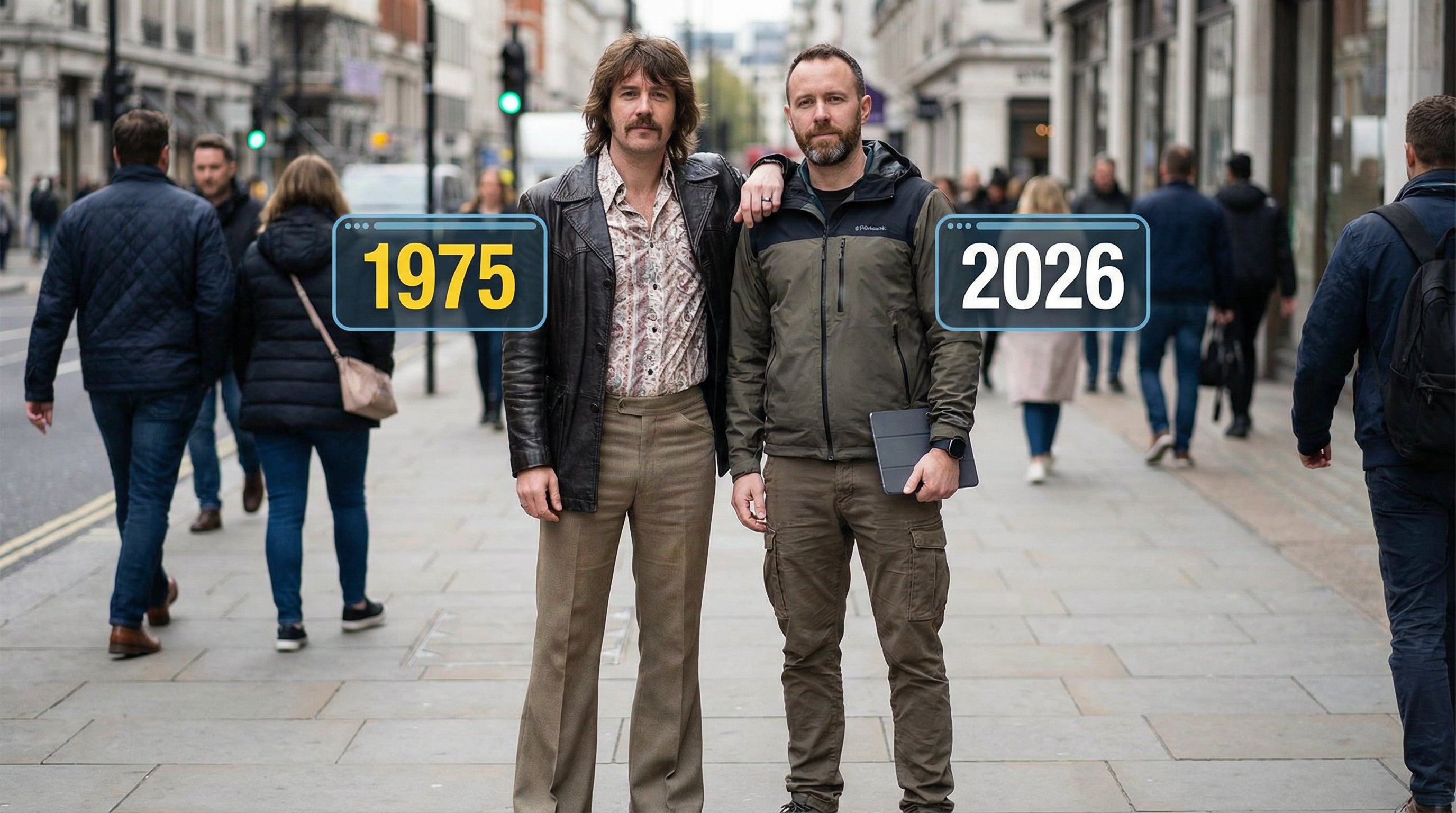
And It’s Not Because You’re Weak… It’s Because Testosterone Has Quietly Collapsed
If you lined up a group of healthy 30-year-old men today next to a group of healthy 30-year-old men from the 1970s or 80s, you’d expect them to look roughly the same hormonally.
Same age. Same biology. Same potential.
They don’t.
Modern men have significantly lower testosterone levels than men of the same age just 40–50 years ago — and this isn’t a fringe theory or internet panic.
It’s one of the most consistent findings in men’s health research over the last two decades.
This Isn’t Aging. It’s a Population-Level Decline.
For a long time, low testosterone was blamed on one thing:
getting older.
That explanation no longer holds.
Large-scale data now shows:
- testosterone has been declining year after year
- the decline is independent of age
- it appears across countries, cohorts, and assay methods
A major global review by Santi et al. analysing testosterone trends across over 1 million men found an average annual decline of ~0.5–0.6% in testosterone levels that could not be explained by aging alone.
Over decades, that adds up to a profound biological shift.
What That Looks Like in the Real World
Several landmark cohort studies help translate this into something concrete:
- Travison et al. (USA) documented an age-independent decline in testosterone in men studied between 1987 and 2004
- Lokeshwar et al. reported a ~25% reduction in total testosterone among U.S. adolescents and young men (15–39 yrs), falling from ~605 ng/dL to ~451 ng/dL
- Andersson (Denmark) and Perheentupa (Finland) showed that later-born male cohorts had lower testosterone than earlier-born men at the same age
- Chodick et al. (Israel, >100,000 men) and Trimpou et al. (Sweden) confirmed similar age-independent declines
In practical terms:
A 30-year-old man today often has testosterone levels closer to what a 40–45-year-old man would have had in previous generations.
That’s not “normal aging”.
That’s a shift in the baseline.
Why This Matters (Beyond Gym Talk)
Testosterone influences far more than muscle or libido.
It plays a role in:
- energy and motivation
- mood and confidence
- body fat distribution
- insulin sensitivity
- bone density
- recovery and resilience
When baseline testosterone drops across a population, the effects appear quietly:
- men feel flat earlier
- recovery slows
- fat gain accelerates
- motivation drops
- libido becomes inconsistent
Because the change is gradual, it’s easy to normalise.
Often, it shouldn’t be.
What’s Driving the Decline?
The evidence points to multiple converging factors, with lifestyle and environment outweighing age as primary drivers.
1. Chronic stress and cortisol
Sustained stress suppresses the hypothalamic-pituitary-testicular (HPT) axis, weakening testosterone signalling from brain to testes.
2. Poor sleep quality
Sleep restriction reduces testosterone production — measurable declines have been observed in as little as one week of short sleep.
3. Increased body fat and insulin resistance
Higher fat mass increases aromatase activity, converting testosterone into estrogen and reducing usable androgen levels.
4. Endocrine-disrupting chemicals (EDCs)
Many plastics, pesticides, and industrial compounds interfere with hormone signalling.
Global plastic production has increased six-fold since the 1970s, and multiple EDCs are now detectable in human tissue.
The concern isn’t acute or one-off exposure — it’s chronic, lifelong exposure.
Free vs Total Testosterone — The Overlooked Detail
Modern men often have higher SHBG (sex hormone-binding globulin).
SHBG binds testosterone, reducing the free (biologically active) fraction.
This explains why many men feel sub-optimal despite being told their labs are “normal”. And might I add the “New Normal” which is significantly lower than “Normal” used to be.
The Quiet Opportunity
This isn’t about panic — and it’s not about blaming men.
It’s about recognising that:
- modern environments are more hostile to hormone health
- testosterone is a system, not a switch
- doing nothing guarantees the trend continues
The encouraging part is that many drivers are modifiable:
- sleep
- stress
- body composition
- micronutrient status
- toxin exposure
No single supplement fixes all of this.
But removing blockers and supporting the system absolutely matters.
References (with links)
-
Travison TG et al.
A population-level decline in serum testosterone levels in American men.
Journal of Clinical Endocrinology & Metabolism, 2007
https://pubmed.ncbi.nlm.nih.gov/17062768/ -
Travison TG et al.
Temporal trends in testosterone levels and treatment in older men.
Journal of Clinical Endocrinology & Metabolism, 2011
https://pubmed.ncbi.nlm.nih.gov/21190955/ -
Lokeshwar SD et al.
Declining testosterone levels in U.S. adolescents and young men.
Andrology, 2020
https://pubmed.ncbi.nlm.nih.gov/32081788/ -
Andersson AM et al.
Secular decline in male reproductive hormones.
Human Reproduction Update, 2007
https://pubmed.ncbi.nlm.nih.gov/17636278/ -
Perheentupa A et al.
Declining testosterone levels in Finnish men.
Journal of Clinical Endocrinology & Metabolism, 2013
https://pubmed.ncbi.nlm.nih.gov/23476030/ -
Chodick G et al.
Secular trends in testosterone among Israeli men.
Andrology, 2020
https://pubmed.ncbi.nlm.nih.gov/32335938/ -
Trimpou P et al.
High-sensitivity testosterone decline across cohorts.
Clinical Endocrinology, 2012
https://pubmed.ncbi.nlm.nih.gov/22486786/ -
Santi D et al.
Testosterone decline and public health implications (review).
Frontiers in Endocrinology, 2018
https://www.frontiersin.org/articles/10.3389/fendo.2018.00296/full -
Endocrine Society
Endocrine-disrupting chemicals (EDCs).
https://www.endocrine.org/topics/edcs


Sleep and Brain Detox: How Deep Sleep Protects Ageing Men
The Best Sleep Supplement: What the Science Actually Says