


Men’s Hormonal Health: What Actually Matters After 30
Most men think hormonal health begins and ends with testosterone. It does not. Men’s hormonal health refers to maintaining healthy function across the entire male endocrine system — a network of chemical messengers that regulate energy, mood, sleep, metabolism, and sexual health simultaneously. Testosterone is part of that picture, but it is not the whole story.
If you have been chasing a single number on a blood panel while ignoring the broader system, this guide will reset your thinking, cut through the marketing noise, and give you a practical framework for what actually matters.
Table of Contents
Key Takeaways
| Point | Details |
|---|---|
| More than testosterone | Men’s hormonal health is a system involving several hormones working together, not just testosterone. |
| Gradual changes are normal | Testosterone declines slowly with age and does not typically cause sudden symptoms. |
| Lifestyle comes first | Resistance training, sleep, nutrition, and stress management are the foundations. |
| Form and dose matter in supplements | Most generic hormone supplements are underdosed. Clinical formulations at correct doses produce different results. |
What Does Men’s Hormonal Health Actually Mean?
Hormones are chemical messengers. They travel through the bloodstream and instruct organs and tissues to perform specific functions. The endocrine system is not a collection of independent switches. It is a tightly interconnected network where each hormone influences others, often in ways that are not immediately obvious.
Most conversations about men’s hormonal health default to testosterone within thirty seconds. That is understandable. Testosterone is the most recognisable male hormone and the one most aggressively marketed to men over 30. But reducing hormonal health to a single molecule is like judging a car’s performance by checking only the oil level. You get some useful information, but you are missing the full picture.
Hormones influence sleep, energy, stress response, metabolism, sex drive, and heart health simultaneously. No single hormone acts in isolation. Understanding men’s hormonal health fundamentals means recognising the system before targeting any part of it.
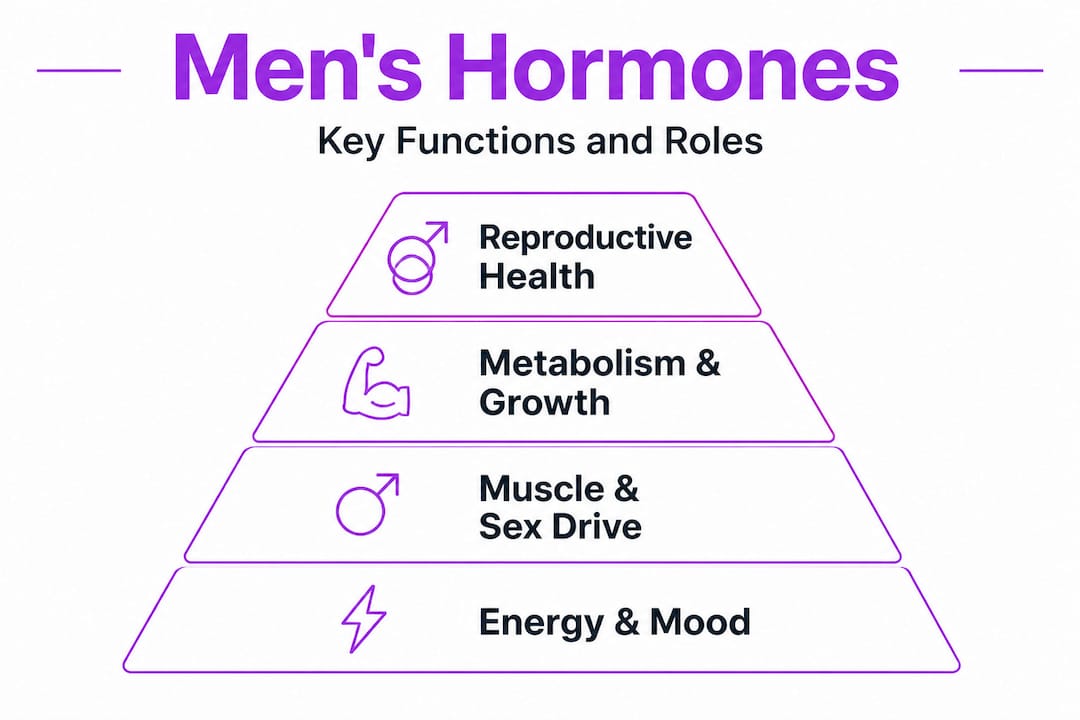
Here is a quick reference for the key hormones in play:
Major male hormones and their primary functions
| Hormone | Primary function | What goes wrong when it is off |
|---|---|---|
| Testosterone | Muscle, bone, libido, mood, energy | Low drive, fatigue, mood changes, muscle loss |
| Cortisol | Stress response, blood sugar regulation | Chronic fatigue, weight gain, poor sleep |
| DHEA | Precursor to sex hormones, energy | Low vitality, reduced resilience |
| Thyroid hormones (T3/T4) | Metabolism, temperature, mood | Sluggishness, weight changes, brain fog |
| Estradiol (oestrogen in men) | Bone density, libido, cardiovascular health | Joint pain, low libido, mood instability |
Key functions at a glance:
-
Testosterone: Drives muscle synthesis, bone density, sperm production, and motivational drive
-
Cortisol: Regulates the acute stress response but becomes destructive when chronically elevated
-
DHEA: Produced by the adrenal glands and serves as a building block for both testosterone and oestrogen
-
Thyroid hormones: Set the metabolic rate and influence nearly every cell in the body
-
Estradiol: Men produce it in small amounts and it is essential for bone health and cardiovascular function
This systems-level view is where real hormonal health begins. Everything else follows from it.
Testosterone: What It Does and Does Not Do
Testosterone is genuinely important. There is no point downplaying that. It plays key roles across the lifespan including sperm production, bone and muscle strength, red blood cell production, sexual function, and a general sense of drive and wellbeing. As men age, it gradually declines, and that decline has real consequences when it crosses into clinically low territory.

What testosterone does not do is operate independently. Its effects are modulated by other hormones, by receptor sensitivity, and by lifestyle factors. A man with normal testosterone on paper but chronically elevated cortisol will still feel flat, fatigued, and unmotivated. The number alone tells you less than the full hormonal picture.
Common symptoms worth paying attention to:
-
Persistent low energy despite adequate sleep
-
Reduced motivation or drive, not just in training but across daily life
-
Mood instability, irritability, or low-grade depression
-
Decreased libido or sexual performance changes
-
Difficulty maintaining or building muscle despite consistent training
-
Increased body fat, particularly around the abdomen
-
Poor concentration or brain fog
-
Sleep disruption, including difficulty staying asleep
On the flip side, testosterone that is too high — whether from exogenous use or other causes — can cause acne, elevated red blood cell counts, mood aggression, and cardiovascular strain.
Testosterone versus other hormones: what each controls
| Function | Testosterone primarily | Shared with other hormones | Other hormones primarily |
|---|---|---|---|
| Sperm production | ✓ | ||
| Muscle protein synthesis | ✓ (growth hormone, insulin) | ||
| Mood and motivation | ✓ (cortisol, dopamine pathways) | ||
| Metabolic rate | ✓ (thyroid hormones) | ||
| Sleep quality | ✓ (melatonin, cortisol) | ||
| Stress resilience | ✓ (cortisol, DHEA) |
Requesting a testosterone test is a reasonable starting point. Do not stop there. Ask your GP to also check thyroid function (TSH, free T3, free T4), DHEA-S, cortisol, and oestradiol. Symptoms matter as much as numbers, and a single testosterone reading without context is rarely the full answer.
Hormonal Changes With Age: What Is Normal and What Is Not
Here is the number that gets used most often and it is worth understanding properly. Testosterone levels decline at roughly 1 to 2 percent per year after the age of 30 in most men. By 40, many men have measurably lower testosterone than they did in their mid-twenties. By 60, the difference can be significant.
What the data actually shows is that this decline is gradual, not abrupt, and many men with lower testosterone levels have no symptoms at all.
The term “male menopause” gets used loosely in media and supplement marketing. It is misleading. Female menopause involves a relatively rapid, dramatic hormonal shift with a clear physiological endpoint. What men experience is a slow, variable decline that may or may not produce noticeable symptoms. Calling it menopause overstates the similarity and sells a significant volume of supplements to men who do not need them.
That said, some men do experience clinically significant low testosterone — hypogonadism — as they age, and for them the symptoms are real and the impact on quality of life is meaningful.
Red flags that warrant a conversation with your GP:
-
Fatigue that does not resolve with rest
-
Sexual dysfunction that is new or worsening
-
Significant unexplained mood changes or depression
-
Loss of muscle mass despite consistent training
-
Bone density concerns or unexplained fractures
-
Hot flushes or night sweats (less common in men, but they do occur)
The distinction between normal ageing and a clinically meaningful hormonal issue matters because the interventions are different. Lifestyle changes address one. Medical treatment may be required for the other.
Lifestyle and Supplement Strategies for Optimal Hormonal Health
The evidence is clear on the clinical hierarchy here. Hormonal optimisation for men over 30 focuses first on lifestyle levers that directly affect testosterone and overall endocrine function. Targeted supplementation fills specific, identified gaps. It does not replace the foundation.
Priority lifestyle strategies, in order of evidence:
-
Resistance training: Compound movements (squats, deadlifts, presses) acutely raise testosterone and over time improve androgen receptor sensitivity. Two to three sessions per week produces measurable hormonal benefit.
-
Sleep quality and duration: Sleep is when testosterone is primarily synthesised. Men sleeping fewer than six hours per night show significantly lower testosterone than those sleeping seven to nine hours. A 2011 University of Chicago study found that one week of restricted sleep reduced testosterone by 10 to 15 percent in healthy young men. This is not a peripheral factor. It is central.
-
Nutritional adequacy: Zinc and magnesium deficiencies are directly linked to lower testosterone. Adequate dietary fat, particularly saturated and monounsaturated fat, supports steroidogenesis — the process by which the body synthesises hormones from cholesterol.
-
Stress management: Chronic cortisol elevation suppresses the hypothalamic-pituitary-gonadal (HPG) axis, directly reducing testosterone production. Structured recovery, breathwork, and reduced stimulant load all have measurable hormonal benefit.
-
Body composition: Adipose tissue converts testosterone to oestrogen via aromatase. Reducing excess body fat, particularly visceral fat, improves the testosterone-to-oestrogen ratio without any supplementation.
What the supplement evidence actually shows:
-
Zinc: Supports testosterone production in men who are deficient. Zinc bisglycinate is the preferred form for absorption — oxide has poor bioavailability. If you are not deficient, additional zinc will not raise testosterone further.
-
Magnesium: Linked to improved free testosterone, particularly in men with low dietary intake or high physical activity. Magnesium glycinate is the preferred form. Magnesium oxide, the most common form in cheap supplements, has very poor bioavailability.
-
Vitamin D3: Functions more like a hormone than a vitamin. Low levels correlate with low testosterone, and supplementation in deficient men shows consistent improvements. Deficiency is extremely common in men who spend most of their time indoors.
-
Rhodiola Rosea (standardised to 3% rosavins, 1% salidroside): Our preferred adaptogen for stress and cortisol management. Clinical trials confirm that Rhodiola significantly reduces the cortisol stress response without the side effect profile seen in other adaptogens. Importantly, it does not blunt drive or motivation — a meaningful distinction for men who need to perform at a high level during the day. For men whose stress levels are not significantly elevated, it supports resilience without overcorrecting.
-
Ashwagandha: Has evidence for reducing cortisol in men under genuine chronic stress. However, many men — particularly those whose baseline stress is not significantly elevated — report a noticeable drop in drive and motivation when taking it. When cortisol is already sitting in a reasonable range, pushing it lower can leave you feeling flat rather than calm. It works for the right person in the right context. It is not a universal recommendation.
-
Tongkat Ali (standardised to eurycomanone): Strong and growing clinical evidence for testosterone support, particularly in stressed and physically active men. The standardisation matters — eurycomanone is the active compound. Generic extracts without standardisation are not equivalent. A 2022 systematic review and meta-analysis in Nutrients confirmed significant improvements in serum testosterone in men using properly standardised Eurycoma longifolia.
-
Fenugreek: Some evidence for supporting free testosterone by inhibiting SHBG (sex hormone-binding globulin). Effect sizes are modest.
-
Tribulus terrestris: Heavily marketed, weakly evidenced. Most clinical trials show no significant testosterone increase in healthy men. The marketing confidence is not matched by the research.
Before adding any supplement, ask three questions. Is there a deficiency or lifestyle gap this is addressing? What does the peer-reviewed evidence say — not the marketing copy? Is the dose clinically relevant? A significant proportion of commercial supplements use doses well below those used in positive clinical trials. The ingredient on the label and the dose required to produce the mechanism are two different things.
Why Real Optimisation Starts With Habits
Men who get lasting results are not the ones who find the right supplement stack first. They are the ones who build the right habits and then use targeted, evidence-based products to fill specific gaps. The supplement industry has spent decades reversing that order.
Optimising hormones is best approached as a system — accounting for testosterone alongside cortisol, thyroid signalling, DHEA, and estradiol — rather than chasing a single lab number. That is not a complicated idea, but it runs directly counter to how most products are marketed. “Boost your testosterone” is a cleaner sell than “support your endocrine system through consistent sleep, resistance training, and targeted micronutrient repletion.”
The critical distinction is between a category of supplements that are poorly formulated and underdosed, and a clinical formulation built around the same evidence base the research uses. Most of the scepticism directed at hormone-focused supplements is deserved and aimed at the former. A product that includes the right ingredients, in the right forms, at the doses used in peer-reviewed trials, is a different product in every meaningful sense. The label scrutiny required to tell the difference is exactly what most marketing is designed to prevent.
Start with an honest audit of your sleep, your training consistency, your diet quality, and your stress load. Fix the obvious gaps first. Then, once the fundamentals are solid, consider targeted supplementation based on actual deficiencies or specific physiological goals — not because a label made a claim, but because the mechanism, the form, and the dose are all accounted for.
The men who maintain hormonal health past 40 are not the ones who found a shortcut. They are the ones who stopped looking for one and built something that compounds.
Take your next step: Simple supports for men’s health
If you have made it this far, you understand that hormonal health is a system, not a single metric, and that lasting results come from building the right foundation before adding targeted support.

Once the lifestyle fundamentals are in place — sleep, training, nutrition, stress management — some men choose to add targeted supplementation to support their daily performance, drive, and resilience. If that is where you are, the products below were formulated to a clinical standard: transparent dosing, evidence-backed ingredients, and forms chosen for bioavailability rather than cost.
Explore Mr Wulf Men Supplements
WULF Test — Daily Support for Drive, Output and Resilience A daily men’s formula built around clinically dosed, standardised ingredients for men over 30 who take their performance seriously. View Wulf Test
The Performance Stack — Day and Night Coverage Wulf Test and Wulf Sleep together, formulated as a system for men who want to support both daytime output and overnight recovery. View The Performance Stack
PRIMAL — Postbiotic Nitric Oxide Booster Designed to support circulation, output, and physical performance. View PRIMAL
Frequently Asked Questions
What are the signs of hormonal imbalance in men?
Common signs include low energy, mood changes, sleep disruption, reduced sex drive, and difficulty building or maintaining muscle. These symptoms can reflect multiple hormonal issues, not just low testosterone, which is why a full panel is worth requesting rather than a single testosterone reading.
Does male menopause really exist?
Not in the way the term implies. Men experience a gradual testosterone decline with age rather than a sudden shift, and many men with lower testosterone levels experience no symptoms at all. The comparison to female menopause overstates the similarity considerably.
Can lifestyle changes really improve men’s hormonal health?
Yes — and they are the most powerful tool available. Resistance training, sleep quality, nutritional adequacy, and stress management all directly influence testosterone and broader endocrine function. In many cases more significantly than supplementation alone.
Are hormone boosting supplements safe and effective?
It depends entirely on the formulation. Generic supplements are often underdosed to the point of clinical irrelevance — the ingredient appears on the label at a fraction of the dose used in the trials that produced positive outcomes. A clinical formulation using the right ingredient forms at the right doses produces different results. Always scrutinise the dose, the form of each ingredient, and whether individual ingredient amounts are disclosed transparently. Consult a qualified health professional before beginning any hormone-related supplement programme.



Why Sleep Supplements Fail: Common Pitfalls Explained
Men's health guide: science-backed habits and supplements