


You are doing everything you think you should. Taking supplements, hitting the gym when life allows, trying to eat reasonably well. Yet somewhere after 30, the energy dips, the recovery slows, and the results stop matching the effort.
The problem is not your commitment. It is that the men’s health industry is flooded with products that are more marketing than mechanism, and most generic advice does not distinguish between what actually moves the needle and what is expensive noise.
This guide does.
Table of Contents
Key Takeaways
| Point | Details |
|---|---|
| Foundations first | Diet, resistance training, and sleep drive the vast majority of outcomes. Supplements fill specific gaps, they do not replace the base. |
| A small number of supplements have strong evidence | Creatine and omega-3s are genuinely well supported. Most others are conditional on deficiency or individual context. |
| Form and dose matter | An underdosed or poorly absorbed ingredient is not the same product as a clinically dosed one, regardless of what the label says. |
| Test before you supplement | Bloodwork tells you what you actually need. Generic supplementation without testing is guesswork at best. |
What Actually Works: Proven Habits and Supplements
The foundation of men’s health is not a supplement stack. It is diet, structured resistance training, and consistent sleep. These three variables drive the vast majority of outcomes in energy, body composition, hormonal health, and cognitive performance. Supplements are a genuine addition on top of that foundation, not a replacement for it.
That said, two supplements stand out from the rest with genuinely robust clinical data.
Creatine monohydrate at 3 to 5g daily improves muscle strength, training performance, and cognitive function, and helps preserve lean muscle mass in men over 30 — particularly when paired with resistance training. Multiple meta-analyses confirm meaningful improvements in strength output and muscle retention. This matters more as natural testosterone and growth hormone levels decline with age.
Omega-3 fatty acids at 1 to 2g of EPA/DHA daily support cardiovascular health, reduce systemic inflammation, contribute to brain function, and improve sperm quality. Most Australian men consume far less oily fish than is recommended. A quality fish oil or algal oil is one of the most straightforward additions you can make.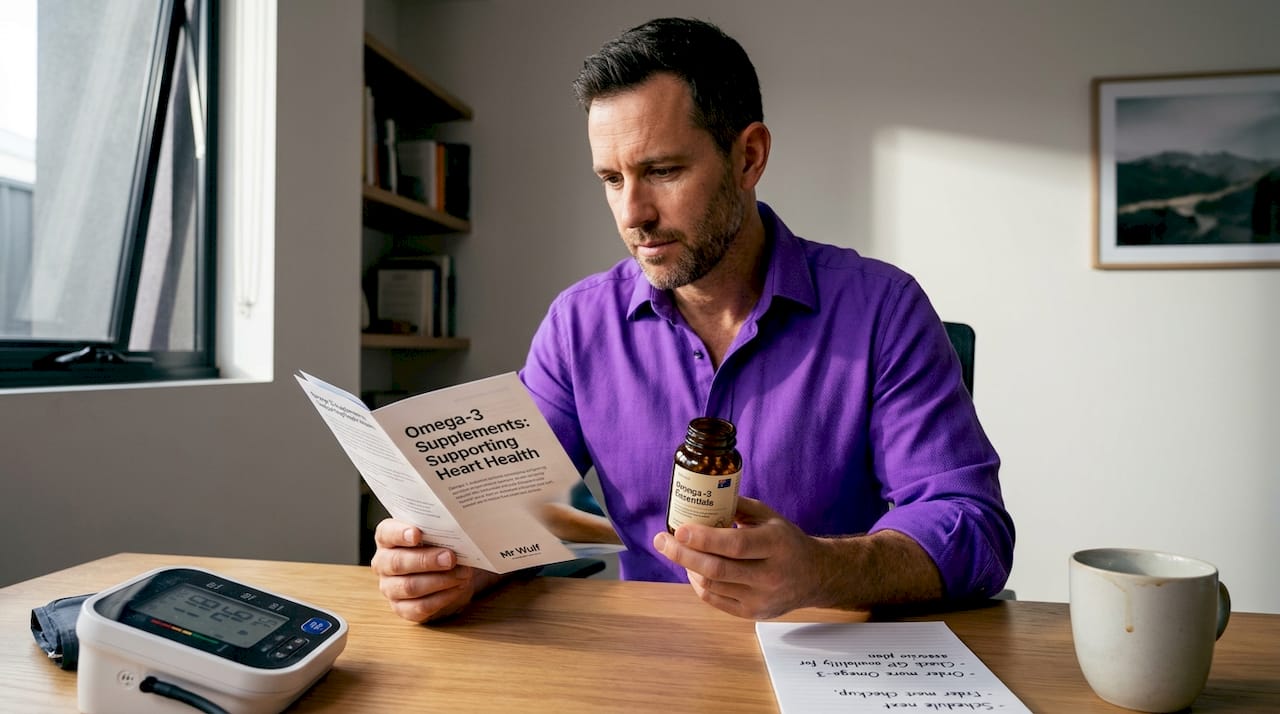
On multivitamins: routine use is not recommended. The evidence for generic multivitamins in healthy men without identified deficiencies is weak, and some formulations use poorly absorbed forms of key minerals. Get tested. Targeted supplementation based on actual deficiencies — particularly vitamin D3 and magnesium — is more effective and more precise.
Top evidence-backed supplements for men over 30:
| Supplement | Daily dose | Primary support | Evidence quality |
|---|---|---|---|
| Creatine monohydrate | 3 to 5g | Strength, muscle, cognition | Very strong |
| Omega-3 (EPA/DHA) | 1 to 2g | Cardiovascular, brain, inflammation | Very strong |
| Vitamin D3 | 1000 to 4000 IU | Bone, immune function, general health | Strong (if deficient) |
| Magnesium glycinate | 300 to 400mg elemental | Sleep, recovery, stress | Moderate to strong |
| Zinc bisglycinate | 25 to 40mg elemental | Immune function, general health | Moderate (if deficient) |
Note on forms: magnesium glycinate and zinc bisglycinate are the chelated, bioavailable forms. Magnesium oxide and zinc oxide, the forms found in most cheap supplements, have poor absorption. The mineral on the label and the mineral reaching your tissue are different things depending on the form used.
Evidence-based daily habits for men over 30:
-
Resistance training at least three times per week to counter age-related muscle loss
-
Seven to nine hours of sleep per night to support recovery and hormonal health
-
Protein intake of 1.6 to 2.2g per kilogram of bodyweight daily
-
Limiting alcohol, which disrupts sleep architecture and suppresses anabolic hormone signalling
-
Managing chronic stress, which elevates cortisol and impairs recovery
The Essential Optimisation Checklist
The biggest mistake men make is layering supplements onto a broken foundation. Poor sleep, inadequate protein, and chronic stress will undermine even the best formulations. Fix the base first.
Routine bloodwork is one of the highest-leverage actions a man over 30 can take. Testing for vitamin D, testosterone (total and free), magnesium, and thyroid function gives you actual data rather than guesswork. Many men are walking around with clinically low vitamin D or suboptimal testosterone and attributing the symptoms — fatigue, poor recovery, low drive — to ageing, when there is a correctable cause.
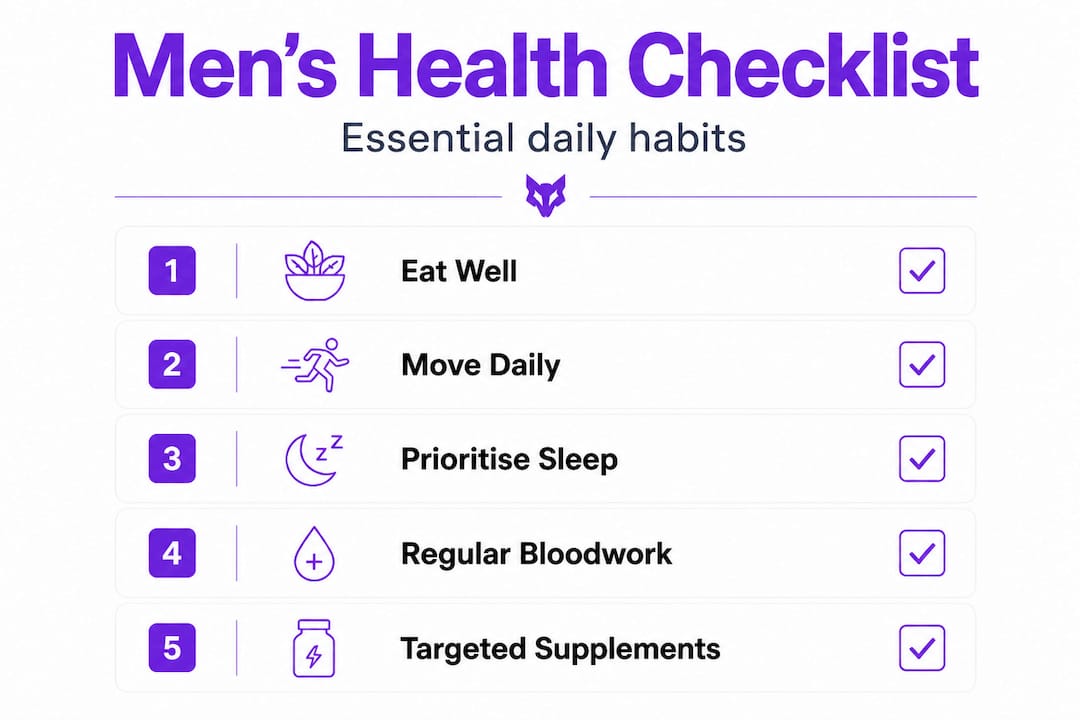
Your optimisation checklist:
-
Get baseline bloodwork including testosterone, vitamin D, magnesium, full blood count, and lipid panel
-
Audit your sleep by tracking duration and quality for two weeks using a wearable or sleep diary
-
Calculate your protein intake and close the gap to 1.6g per kilogram of bodyweight minimum
-
Structure your training around compound resistance movements at least three sessions per week
-
Identify your top two stressors and build one daily stress-reduction practice — breathwork, walking, or deliberate downtime
-
Introduce creatine monohydrate once training and nutrition are consistent
-
Add omega-3s if your oily fish intake is less than two servings per week
-
Supplement targeted deficiencies only, based on your bloodwork results
Key health markers and what to do with them:
| Health marker | Optimal range | Action if low |
|---|---|---|
| Vitamin D (25-OH) | 75 to 150 nmol/L | Supplement D3 with K2 |
| Total testosterone | 15 to 30 nmol/L | Review sleep, training, body fat first |
| Magnesium (serum) | 0.85 to 1.10 mmol/L | Supplement magnesium glycinate |
| Fasting glucose | 3.9 to 5.5 mmol/L | Review diet and activity |
How to Build Your Routine: Step by Step
The framework is straightforward: test, nourish, train, recover. In that order.
-
Test first. Get your bloodwork done before buying a single supplement. This prevents wasted money and prevents supplementing nutrients you do not need in excess.
-
Nourish the base. Hit your protein targets daily. Prioritise whole foods, vegetables, quality fats, and complex carbohydrates. Hydration matters more than most men acknowledge, particularly for cognitive performance and recovery.
-
Train with structure. Progressive overload — gradually increasing the demand on your muscles over time — is the stimulus that makes creatine and protein work. Without it, you are supplementing for nothing.
-
Recover deliberately. Sleep is where muscle is repaired, the nervous system resets, and the majority of anabolic hormone release occurs. Treat it as a training variable, not an afterthought. If sleep quality is a problem, address it specifically — not with sedatives or melatonin at consumer doses, but with a formulation built around the actual mechanisms of sleep onset and maintenance.
-
Layer in proven supplements. Once steps one through four are consistent, add creatine monohydrate at 3 to 5g daily and omega-3s at 1 to 2g EPA/DHA. These are the two supplements with genuinely strong evidence across the broadest range of outcomes for men over 30.
-
Adjust over time. Reassess bloodwork every six months. Track training performance. Note energy and mood trends. Adjust based on real data, not marketing.
Key supplements and when to take them:
-
Creatine monohydrate: daily, any time, with food or water
-
Omega-3s: with a meal containing fat for better absorption
-
Vitamin D3 with K2: morning, with breakfast
-
Magnesium glycinate: 30 to 60 minutes before bed
Common Pitfalls and Myths to Avoid
The men’s health supplement market is worth billions. A significant portion of that revenue comes from products with minimal clinical evidence — and a marketing infrastructure designed to obscure the gap between what a product claims and what it can deliver.
Common mistakes men make:
-
Buying before testing. Supplementing zinc when you are not deficient can suppress copper absorption and create new problems. Test first.
-
Chasing proprietary blends. Many products hide individual ingredient doses behind proprietary blend labels. This is a common sign that each ingredient is present at a fraction of the dose used in clinical trials. An ingredient on the label is not the same as an ingredient at a working dose.
-
Ignoring the fundamentals. No supplement compensates for chronic sleep deprivation, a poor diet, or a sedentary lifestyle. The physiology does not work that way.
-
Assuming natural means safe. Many herbal supplements interact with medications or have dose-dependent risks. Non-toxic is the standard worth applying — not natural, which tells you very little about safety or efficacy.
-
Following one-size-fits-all programmes. Your hormonal profile, training history, stress load, and dietary habits are specific to you. Generic routines produce generic results.
-
Expecting results too quickly. Most men expect meaningful change in two to three weeks. Meaningful physiological change — particularly in body composition and hormonal health — takes three to six months of consistent effort. Patience is not passive. It is part of the strategy.
The supplement industry profits from complexity and confusion. The more overwhelmed you feel, the more products you consider. Simplicity built on evidence is both cheaper and more effective than a cabinet full of half-used bottles.
Tracking Your Progress
Tracking does not need to be complicated. Four metrics tell you almost everything you need to know.
-
Training performance. Are you lifting more, recovering faster, or completing more volume than last month? If your numbers are moving in the right direction, the fundamentals are working.
-
Sleep quality. Track duration and how rested you feel on waking. Improvements in magnesium status and sleep hygiene typically show up here within two to four weeks.
-
Energy and mood. Rate your afternoon energy and general mood on a simple one to ten scale each day. Trends over four to six weeks are meaningful. Day-to-day variation is noise.
-
Bloodwork at six months. Retest your key markers. Has your vitamin D moved into the optimal range? Has testosterone tracked with improved sleep and training? The numbers confirm whether your interventions are producing physiological change.
Why Most Men’s Health Routines Fail
Most routines fail not because of bad products or poor intentions. They fail because they are overcomplicated from the start and built on a foundation of marketing rather than physiology.
The industry has a financial incentive to keep you confused. A man who understands that creatine, omega-3s, quality sleep, and consistent training cover 80% of his needs is not a profitable customer. So complexity gets sold as sophistication. Stacks get sold as systems.
What actually works, consistently, is simpler. Pick two or three evidence-backed supplements. Build a training routine you can maintain. Treat sleep as seriously as training. Do not chase trending ingredients. Stay the course.
The other failure pattern is the absence of honest self-assessment. Most men know whether they are sleeping poorly, drinking too much, or skipping training sessions. It is easier to buy a new supplement than to fix a behaviour. The data is clear: no formulation outperforms a consistent lifestyle.
The most effective men’s health routine is also the least exciting one. Eat well, train consistently, sleep properly, address real deficiencies, and use a small number of proven supplements. Everything else is noise.
Further Support
The Mr Wulf Men blog covers the evidence behind specific ingredients, sleep science, hormonal health, and performance nutrition — with the same standard applied here: mechanism first, marketing never.
Explore Mr Wulf Men Supplements
Wulf Sleep — Natural Sleep Support Formula Formulated for men whose sleep quality has declined. Ten clinically dosed ingredients supporting sleep onset, cortisol management, and overnight recovery. View Wulf Sleep
WULF Test — Daily Men’s Formula A daily formula for men over 30 focused on drive, output, and physical resilience. Transparent dosing, standardised ingredients, clinically relevant amounts. View Wulf Test
The Performance Stack Wulf Test and Wulf Sleep together, for men who want to support both daytime output and overnight recovery in one system. View The Performance Stack
WULF Creatine — Micronised Creatine Monohydrate 3 to 5g daily. No loading phase required. One of the most consistently supported supplements in the men’s health literature. View Wulf Creatine
These products are not intended to diagnose, treat, cure, or prevent any disease or health condition. Always consult a qualified health professional before beginning any supplement programme.
Frequently Asked Questions
What is the best supplement for men over 30?
Creatine monohydrate and omega-3s have the strongest clinical evidence across the broadest range of outcomes for men over 30 — strength, cognitive function, cardiovascular health, and inflammation. Beyond those, vitamin D3 and magnesium glycinate are worth considering if bloodwork confirms deficiency. Everything else is conditional on individual context.
Are multivitamins worth taking?
Not as a default. Generic multivitamins rarely address specific deficiencies effectively, and the forms used for minerals are often poorly absorbed. Targeted supplementation based on tested deficiencies is more precise and more effective.
How do I know if my supplements are working?
Track training performance, sleep quality, energy, and mood over four to six weeks. Retest bloodwork at six months. Subjective improvement that is not confirmed by either performance data or bloodwork is difficult to attribute to supplementation specifically.
Is all men’s health advice based on evidence?
No. A significant proportion of supplements marketed to men have limited or no clinical evidence for their claimed benefits at the doses used. The standard worth applying is: what is the mechanism, what does the peer-reviewed research say, and is the dose in this product the dose used in the trials that produced positive outcomes. If a brand cannot answer all three, that is the answer.



Men's hormonal health: vitality, balance, and wellbeing
How to improve men's sleep for better health and recovery