


Mental performance is not one vague concept your brain either has or lacks. It is a collection of measurable cognitive abilities — attention, memory, processing speed, executive function — each following its own trajectory as you age. If you are a man past 30 and have noticed that names slip away faster, mid-afternoon fog hits harder, or that problem-solving feels more laborious than it once did, the instinct is to chalk it up to getting older. That instinct is wrong, or at least dangerously incomplete. The science shows that most of what drives cognitive decline is modifiable, and the men who understand this early are the ones who stay sharp longest.
Table of Contents
Key Takeaways
| Point | Details |
|---|---|
| Mental performance is domain-specific | Memory, processing speed, and executive function are distinct and respond to different interventions. |
| Age-related decline is not inevitable | Most of the drivers of cognitive decline in men over 30 are modifiable through lifestyle. |
| Objective benchmarking produces better decisions | Standardised tools like MMSE and MoCA give you actual data rather than a subjective sense of sharpness. |
| Sleep and exercise are the primary levers | Both have the strongest and most consistent evidence for cognitive protection and improvement. |
| Match the intervention to the deficit | A man whose processing speed is lagging needs different strategies than one whose working memory is the issue. |
What Mental Performance Actually Measures
The term gets used loosely in marketing copy and casual conversation, but cognitive science is precise about it. Mental performance is operationalised as a set of measurable abilities assessed through neuropsychological testing. These abilities are separable — which matters enormously, because a targeted intervention can improve one domain without necessarily moving the needle on another.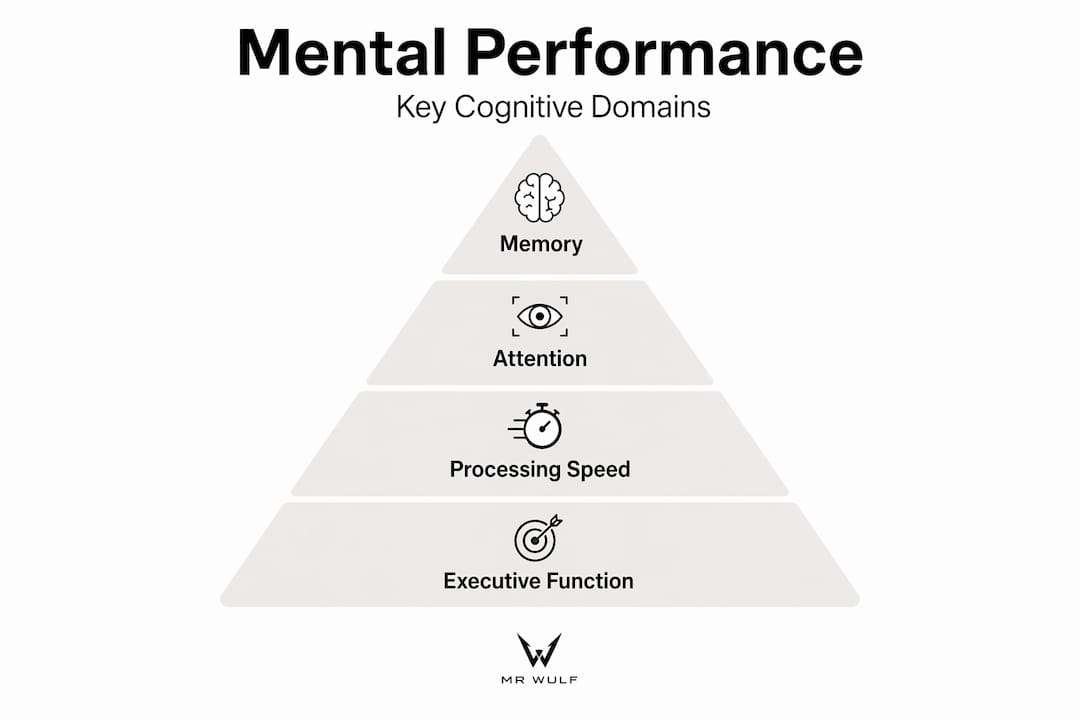
The primary cognitive domains relevant to men over 30:
-
Attention and concentration: Sustaining focus and filtering distractions over time
-
Working memory: Holding and manipulating information in real time — running numbers in your head, tracking a multi-step argument
-
Processing speed: How quickly the brain encodes, retrieves, and responds to information
-
Executive function: Planning, decision-making, impulse control, and task-switching
-
Fluid intelligence: Solving novel problems without relying on prior knowledge
-
Spatial reasoning: Mentally rotating objects, reading maps, and visualising three-dimensional structures
Each responds differently to interventions. A man whose processing speed is lagging needs different strategies than one whose working memory is the weak link. Generic “brain health” habits are less effective than targeted interventions matched to your specific cognitive profile.
Standardised screening tools give an objective view. The Mini-Mental State Examination (MMSE) scores out of 30 and tests orientation, recall, language, and visuospatial skills. The Montreal Cognitive Assessment (MoCA) is more sensitive to subtle deficits and includes more executive function tasks. Both are validated instruments used in population studies and clinical settings worldwide.
| Cognitive domain | Example task | Primary test used |
|---|---|---|
| Working memory | Repeating digits backwards | MMSE, digit span tests |
| Processing speed | Symbol substitution tasks | Trail Making Test Part A |
| Executive function | Alternating sequences | MoCA, Trail Making Test Part B |
| Language and recall | Naming, three-word recall | MMSE |
| Visuospatial skills | Copying a cube or clock | MoCA clock drawing |
How Mental Abilities Shift as Men Age
Not all cognitive abilities follow the same slope. Research consistently shows that different mental abilities peak at different ages, with some beginning to decline as early as the mid-30s while others remain robust well into the 40s and beyond.
Short-term memory — the raw capacity to hold new information — peaks around 25. Processing speed starts showing measurable drops from the mid-30s onward. Fluid intelligence and spatial reasoning tend to peak into the early 40s. These trajectories are not deterministic. They represent population averages, and individual variation is substantial depending on lifestyle, health, and cognitive engagement.
Crystallised intelligence — accumulated knowledge and expertise built over a lifetime — continues improving well into the 60s for many men. This is why an experienced engineer or strategist in their 50s can outperform a faster-processing 25-year-old on complex real-world problems. Raw speed declines; applied wisdom accrues.
The important distinction is between normative age-related change and accelerated decline driven by modifiable factors. Testosterone decline plays a role in some cognitive shifts — testosterone receptors are present in brain regions governing memory and spatial cognition — but it is far from the dominant driver. Sleep debt, chronic stress, dietary inflammation, alcohol intake, sedentary behaviour, and social isolation all independently impair cognitive function to a greater combined extent than hormonal shift in most men over 30. Attributing all cognitive change to ageing or testosterone without evaluating these factors is a missed opportunity.
Benchmarking Your Mental Performance
Subjective self-assessment of cognitive function is unreliable. Men consistently overestimate their processing speed and working memory, particularly under chronic sleep deprivation where the subjective experience of impairment is blunted even as objective performance deteriorates. This is well documented in sleep research and is one of the reasons cognitive benchmarking with standardised tools is more useful than introspection.
Population norms for MMSE and MoCA provide context for where you stand relative to your age group. For healthy men aged 70 and above, population studies show median MMSE around 29 and MoCA around 26, with scores varying by education level. For younger men, the expected scores are higher and decline less clear-cut — which is precisely why early baseline measurement is valuable. You cannot track change without a baseline.
Practical starting points for objective cognitive assessment:
-
MMSE and MoCA: Administered by GPs and neuropsychologists. A GP can perform a brief cognitive screen during an annual checkup.
-
Cogstate and Cambridge Brain Sciences: Validated online platforms providing domain-specific testing across memory, processing speed, and executive function.
-
Trail Making Test: Available online; measures processing speed (Part A) and executive function (Part B).
Track scores over time, not as a diagnostic exercise, but as a performance variable. Just as you would monitor VO2max or grip strength, cognitive benchmarks give you data to act on.
Lifestyle Levers That Move the Needle
The evidence for lifestyle interventions on cognitive performance is more robust than most men realise, and the mechanisms are well understood.
Sleep is the first lever. Memory consolidation — the process by which the brain transfers short-term experience into long-term storage — occurs primarily during slow wave and REM sleep. A single night of poor sleep degrades working memory, processing speed, and executive function measurably the following day. Chronic sleep restriction produces cumulative deficits that do not fully reverse with a single recovery night. Seven to nine hours of consolidated sleep per night is not a performance preference. It is the biological requirement for proper cognitive function.
The mechanism is direct: during slow wave sleep, the glymphatic system — the brain’s waste clearance pathway — flushes metabolic byproducts including amyloid-beta, the protein that accumulates in neurodegenerative conditions. Sleep debt is not just performance-impairing in the short term. It is a long-term cognitive risk factor.
Exercise is the second most powerful lever. Aerobic exercise specifically increases brain-derived neurotrophic factor (BDNF), a protein that promotes neuron growth and synaptic plasticity — literally the biological substrate of learning and memory. Resistance training supports testosterone levels, which in turn influence processing speed and spatial cognition. The evidence-supported target is 150 minutes per week of moderate-intensity aerobic activity plus two to three resistance sessions. This is achievable and the cognitive return is well documented.
Nutrition shapes neurochemistry more directly than most men realise. Omega-3 fatty acids, particularly DHA, are structural components of neuronal membranes. Magnesium supports synaptic transmission and GABA signalling. B vitamins — especially B12 and folate — are critical for methylation pathways affecting neurotransmitter synthesis. A diet high in ultra-processed foods chronically elevates systemic inflammation, which directly impairs hippocampal function and memory consolidation.
Key actionable habits:
-
Prioritise 7 to 9 hours of sleep with consistent wake and sleep times, including weekends
-
Train aerobically at least 3 to 4 days per week, elevated heart rate for 30 or more minutes
-
Eat oily fish twice weekly or supplement with quality DHA-rich omega-3s
-
Practise active recall when learning new information rather than passive re-reading — retrieval practice is demonstrably superior for memory consolidation
-
Limit alcohol to fewer than 10 standard drinks per week — even moderate drinking accelerates hippocampal volume loss over time
-
Maintain social engagement — isolation correlates with accelerated cognitive decline across every demographic studied
Chunking information (grouping related items into meaningful clusters) and spaced repetition (revisiting material at increasing intervals) are two cognitive strategies with decades of evidence behind them. They reinforce the neural pathways that encode memory, making recall faster and more reliable. Both can be applied to any learning context without specialised tools.
What Most Men Get Wrong After 30
The two most common errors are at opposite ends of the response spectrum. The first is ignoring cognitive change entirely and attributing it to ageing without investigation. The second is immediately framing it as a testosterone problem and pursuing hormonal solutions without any objective assessment of what is actually happening.
Neither serves the outcome.
Cognitive decline in men over 30 is multifactorial. Sleep debt, chronic stress, dietary inflammation, alcohol, sedentary behaviour, and social isolation all independently impair cognitive function — often to a greater extent than hormonal change at this stage of life. Attributing every instance of brain fog to testosterone without evaluating these factors is not just simplistic. It is a missed opportunity that can cost years of preventable decline.
The second trap is relying on generic brain-boost products without understanding which cognitive domain they are supposed to support, at what dose, and with what specific evidence. The supplement industry consistently pixie-dusts proprietary blends with ingredients that have real science behind them but are included at fractions of effective doses. Understanding how men’s hormonal health interacts with cognitive function gives you the foundation to ask the right questions before spending money on claims you cannot evaluate.
The men who stay sharp longest are not the ones who found the right supplement. They are the ones who understood which cognitive domain needed attention and applied the right evidence-based tool to it.
Further Support
The Mr Wulf Men blog covers the science behind sleep, hormonal health, physical performance, and supplementation — all directly relevant to cognitive performance — with the same standard applied throughout: mechanism first, marketing never.

Explore Mr Wulf Men Supplements
Wulf Sleep — Natural Sleep Support Formula Sleep is the highest-leverage cognitive intervention available. Ten clinically dosed ingredients addressing sleep onset, cortisol management, and deep sleep architecture — the overnight foundation that cognitive performance depends on. View Wulf Sleep
WULF Test — Daily Men’s Formula for Drive, Output and Resilience For men who have the lifestyle foundation in place. Testosterone and cortisol directly influence processing speed, spatial cognition, and executive function. Clinically dosed, standardised ingredients. Transparent label. View Wulf Test
The Performance Stack — Day and Night Coverage Wulf Test and Wulf Sleep together, addressing both the hormonal and recovery foundations of cognitive performance simultaneously. View The Performance Stack
Frequently Asked Questions
What is the most accurate way to assess mental performance in men over 30?
Standardised tools like the MMSE and MoCA provide validated scores with population norms for comparison. A GP can administer a brief cognitive screen at an annual checkup. For domain-specific assessment, validated online platforms such as Cogstate or Cambridge Brain Sciences test memory, processing speed, and executive function separately.
Can mental performance improve after 30 or is decline inevitable?
Decline is not inevitable. Cognitive abilities can improve or be preserved with consistent lifestyle habits — particularly sleep quality and aerobic exercise — and targeted interventions matched to your specific cognitive profile. The drivers of most cognitive decline in men over 30 are modifiable.
Are hormonal changes the main cause of cognitive decline for men over 30?
Not primarily. Brain fog and cognitive decline have multifactorial causes, including sleep deprivation, chronic stress, poor diet, sedentary behaviour, and social isolation — all of which impair cognition independently of hormonal status. Testosterone does influence some cognitive domains but is rarely the dominant driver in men under 50 without clinical hypogonadism.
Which lifestyle habits have the biggest impact on mental performance?
Quality sleep, regular aerobic exercise, and a diet rich in omega-3s and B vitamins deliver the most consistently evidenced cognitive benefits. The mechanisms are well understood — BDNF elevation from exercise, glymphatic clearance during sleep, and neurochemical support from dietary inputs.



Lifestyle optimisation: Evidence-backed strategies for men over 30
Lactium for Sleep: The Calm-First Ingredient With Real Clinical Numbers