


Most men over 30 quietly accept that fatigue, declining sharpness, and a nagging sense of being off are simply part of getting older. That assumption is wrong, and the evidence is unambiguous about it.
Lifestyle optimisation is a deliberate, science-informed process of refining daily behaviours to produce measurable improvements in health, performance, and vitality. Not a wellness trend. Not another programme to follow for three weeks and abandon. A practical, evidence-backed framework built around sleep, nutrition, exercise, and stress management — four pillars with decades of robust clinical support and direct causal links to the outcomes most men care about most.
Table of Contents
Key Takeaways
| Point | Details |
|---|---|
| Deliberate approach over passive acceptance | Lifestyle optimisation requires measuring, adjusting, and re-measuring rather than following generic rules. |
| Four pillars drive most outcomes | Sleep, nutrition, physical activity, and stress management have the most consistent clinical evidence for men over 30. |
| Precision nutrition is promising but not yet mature | Tailored dietary approaches have real science behind them. Validated tools at accessible cost are still catching up. |
| Measurement turns intention into results | Tracking sleep, fitness, and biomarkers removes guesswork and gives you specific, actionable targets. |
| Consistency over complexity | The basics, done consistently for 12 months, outperform any aggressive short-term protocol. |
What Lifestyle Optimisation Actually Means
Lifestyle optimisation is not the same as generic wellness advice. Telling someone to eat better and sleep more is not optimisation. Optimisation is intentional. It involves selecting evidence-based behaviours, measuring the health outcomes those behaviours produce, and iterating based on what your data actually shows.
Traditional wellness models are largely static. They hand you a set of rules, a meal plan, or a generic exercise routine and expect you to follow them indefinitely. Lifestyle optimisation treats health as a dynamic system where inputs, environment, and biology are always changing. The task is to track the outputs and adjust accordingly.
| Traditional wellness | Lifestyle optimisation |
|---|---|
| Fixed rules and programmes | Iterative, data-driven adjustments |
| Generic recommendations | Individually measured outcomes |
| Compliance-based | Curiosity-based |
| Passive acceptance of decline | Active intervention |
| One-size-fits-all | Tailored to your biology and goals |
The Global Wellness Institute frames wellness as an active pursuit shaped by environment and the choices made within it — not something that happens to you, but something you construct. For men over 30, whose hormonal, metabolic, and recovery capacity are all beginning to shift, that active framing is not optional. It is the difference between managing decline and redirecting it.
The four domains where optimisation produces the most measurable results are sleep quality, nutritional strategy, physical movement, and stress regulation. Understanding the science-backed habits and male vitality strategies behind each makes the mechanisms visible rather than abstract.
The Four Core Pillars and What the Evidence Shows
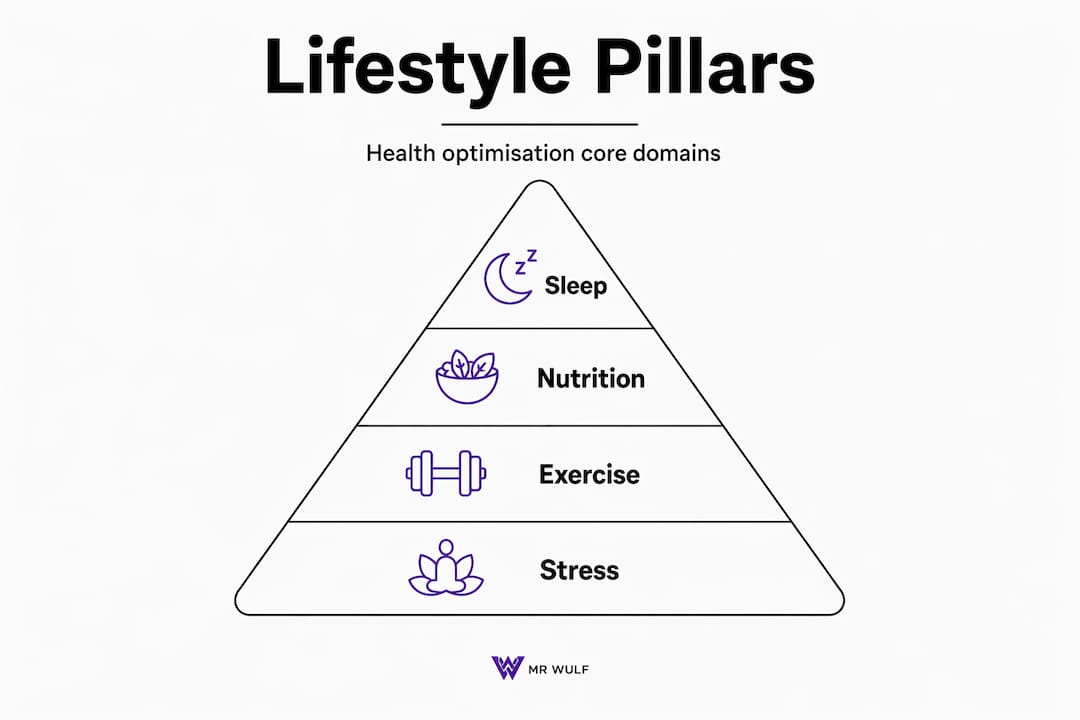
Each pillar is independently important and interconnected. Neglect one and the others suffer. Optimise all four and the cumulative effect compounds across every dimension of health and performance.
Sleep
Sleep is not passive recovery. During sleep, the body repairs tissue, consolidates memory, regulates hormonal output including testosterone and growth hormone, and modulates inflammation. The majority of daily testosterone is synthesised during slow wave sleep. Chronically disrupted sleep does not just leave men tired — it suppresses anabolic hormone output, elevates cortisol, impairs insulin sensitivity, and degrades the resilience needed to sustain performance across a demanding day.
Most men over 30 are chronically undersleeping without realising it. The target is 7 to 9 hours of consolidated sleep per night. But duration is not the only variable. Sleep architecture — the ratio of light, deep, and REM sleep — determines recovery quality more than time in bed alone. A man who spends 8 hours in bed but cycles through shallow sleep due to elevated evening cortisol is not getting 8 hours of benefit.

Evidence-backed sleep improvements for men over 30 include: maintaining a consistent bed and wake time seven days a week, keeping the bedroom between 18 and 20 degrees Celsius, avoiding screen exposure for 60 to 90 minutes before bed, and cutting caffeine off by 2pm. These are not exotic interventions. They are boring and effective, which is the combination that actually produces results.
For a detailed breakdown of sleep mechanisms and recovery, the men’s sleep guide covers the physiology and the practical protocol in full.
Nutrition
Nutrition is where most men overcomplicate things badly. The evidence does not support optimising macros to the gram, following elimination protocols, or cycling through whatever dietary framework is trending. What the evidence consistently supports is adherence to a dietary pattern — not a diet — that emphasises whole foods, adequate protein, vegetables, healthy fats, and limited processed carbohydrates and alcohol.
Protein intake of 1.6 to 2.2 grams per kilogram of bodyweight daily is the threshold supported by the muscle protein synthesis literature for men in active training. Below this range, lean mass maintenance becomes progressively harder after 35, regardless of training quality.
Sustained dietary and lifestyle changes significantly reduce cardiovascular risk — the leading cause of death in Australian men. The evidence base for lifestyle-preventable cardiovascular events is substantial and well established across multiple large cohort studies, though individual risk profiles vary and clinical guidance from a GP remains the appropriate standard for men with existing cardiovascular concerns.
Exercise
Exercise should match your lifestyle and goals, not an idealised standard. The evidence-based minimum for meaningful health outcomes is 150 to 300 minutes of moderate intensity aerobic activity per week, combined with two resistance training sessions targeting all major muscle groups. Beyond that minimum, additional benefit accrues but returns begin to flatten. What matters most is consistency across years, not intensity across weeks.
Resistance training is particularly important for men after 35. Testosterone decline, reduced growth hormone output, and age-related muscle fibre shift all accelerate muscle loss in the absence of adequate progressive loading. Three to four compound sessions per week, built around squats, deadlifts, rows, and presses, provides the anabolic stimulus that counteracts this trajectory.
Aerobic training preserves VO2max — the single strongest predictor of all-cause mortality available outside of clinical medicine. Men in the top quartile of cardiorespiratory fitness for their age show dramatically lower mortality risk than those at average or below. Zone 2 cardio at 60 to 70% of maximum heart rate, three to four times per week for 30 to 60 minutes, produces measurable VO2max improvements within six to eight weeks.
Stress Management
Stress management is the most underrated of the four pillars and the one most likely to be treated as optional. Chronic psychological stress elevates cortisol, suppresses testosterone production, degrades sleep quality, drives inflammatory pathways, and impairs decision-making. These are not indirect or theoretical effects. They are direct, documented, and measurable.
Simple daily practices with consistent clinical support include structured breathwork such as box breathing (four seconds in, hold four, out four, hold four), time-blocking to reduce decision fatigue, deliberate nature exposure for 20 minutes daily, and hard boundaries on work communications outside business hours.
Adaptogenic supplementation can complement these practices once the foundational habits are in place. Rhodiola Rosea standardised to 3% rosavins is the preferred adaptogen for cortisol management and stress resilience in the performance context — supporting the stress response without the drive-suppression profile some men experience with ashwagandha. The adaptogen science article covers the evidence and the important distinctions between specific ingredients in detail.
Key markers to track across all four pillars:
-
Resting heart rate and heart rate variability (HRV)
-
Waist circumference as a proxy for visceral fat
-
Fasting glucose and blood lipid panel
-
Sleep quality scores from a wearable device
-
Grip strength and VO2 max estimate
-
Subjective energy, mood, and focus rated on a simple daily scale
Personalised Nutrition and Precision Health: What Is Real and What Is Not
After understanding the foundations, many men wonder whether there is a single best dietary approach. Personalised nutrition is emerging as a genuinely important development, but it deserves an honest assessment rather than uncritical enthusiasm.
The core premise of precision nutrition is well founded. Different people produce substantially different metabolic, glycaemic, and hormonal responses to the same foods. Two men eating identical meals can have wildly different blood glucose trajectories, fat oxidation rates, and inflammatory markers. This variability means that population-level dietary guidelines, while useful as a starting point, cannot capture what will work best for a specific individual.
A 2025 review published in Nature Medicine characterised precision nutrition as a promising complement to standard one-size-fits-all guidelines, while acknowledging it is not yet fully deployable at scale. The science is advancing rapidly. The validated tools at accessible cost are still catching up to the ambition.
What precision nutrition currently offers at an accessible level:
-
Continuous glucose monitoring (CGM) to observe real-time glycaemic responses to specific foods
-
Gut microbiome testing to identify dietary patterns that support individual microbial profiles
-
Blood biomarker panels including fasting insulin, homocysteine, omega-3 index, and vitamin D
-
Genetic panels identifying variations in genes related to fat metabolism, caffeine clearance, and folate processing
What it does not yet reliably deliver is a fully individualised meal plan proven to outperform a well-structured whole-foods diet for most men over 30. The data is promising. The delivery is still maturing.
The practical implication: before spending money on advanced precision health testing, spend 30 days tracking what you actually eat using a simple food log. Most men discover that their real dietary patterns differ substantially from what they believe they are eating. That honest baseline is more actionable than any test you can buy.
A Practical Measurement and Iteration Framework
Understanding the science is genuinely useful. Converting that understanding into a repeatable daily system is where results actually come from.
Practical operationalisation means choosing high-impact behaviours, tracking health outputs, and adjusting based on what actually moves your markers — not what worked for someone else, not what is currently trending.
A step-by-step framework:
-
Audit your current state. Measure your baseline across the key metrics listed above. Weight, waist circumference, resting heart rate, sleep quality, fasting glucose. You cannot improve what you have not measured.
-
Identify your highest-impact lever. Where is the biggest gap between current state and target state? For most men over 30, that lever is either sleep quality or physical inactivity.
-
Select two to three specific behaviours. Not goals. Behaviours. “In bed by 10:30pm every weeknight” is a behaviour. “Sleep better” is not.
-
Track weekly for four weeks. Use a spreadsheet, a notes app, or a health wearable. Log target behaviours and key health outputs consistently.
-
Review your data at week four. Which behaviours moved your markers? Which did not? Keep what works. Adjust or discard what does not.
-
Add the next lever. Once the first target area is stabilised, introduce the next domain. Sleep, then nutrition, then exercise, then stress management is the logical sequence for most men.
This iterative approach mirrors the structure of the men’s performance checklist — the value is in the cycle, not the perfection of any single plan.
What Most Men Get Wrong and Why Simplicity Wins
The vast majority of men who commit to lifestyle optimisation make the same mistake within the first 60 days. They replace one set of complicated, unproven behaviours with another. They swap one trend for the next instead of mastering the fundamentals.
The pattern is consistent. A man starts well, runs a decent sleep protocol for two weeks, gets impatient when the results are not dramatic, and pivots to intermittent fasting, then cold exposure, then red light therapy. None of those approaches are inherently wrong. But deployed before the basics are locked in, they are distractions. They add complexity without fixing the leverage points where the real deficit lives.
The science-backed habits that produce compounding health improvements for men over 30 are not exciting. Consistent sleep timing. Adequate dietary protein. Regular resistance and aerobic training. Daily stress management. Those four, done consistently across 12 months, will produce more measurable improvement in testosterone, body composition, cardiovascular fitness, and cognitive performance than any trending supplement stack.
The other thing most men miss is that optimisation is never finished. Biology changes, life circumstances shift, stress load varies by season, sleep needs evolve. An effective lifestyle optimisation system is not a plan you follow to a destination. It is a feedback loop you run indefinitely. The men who achieve the best long-term results are not the ones who followed the most aggressive protocol. They are the ones who stayed consistently curious and honest about their own data.
Simplicity scales. Complexity breaks.
Further Support
The Mr Wulf Men blog covers each of these pillars in detail — sleep science, hormonal health, physical performance, adaptogens, and supplement formulation — with the same standard applied throughout: mechanism first, marketing never.
Explore Mr Wulf Men Supplements
Wulf Sleep — Natural Sleep Support Formula For men whose sleep quality has declined. Ten clinically dosed ingredients addressing sleep onset, cortisol management, and deep sleep architecture. The overnight foundation that everything else depends on. View Wulf Sleep
WULF Test — Daily Men’s Formula for Drive, Output and Resilience For men who have the lifestyle foundation in place and want targeted daily support. Clinically dosed, standardised ingredients. Transparent label. No proprietary blends. View Wulf Test
The Performance Stack — Day and Night Coverage Wulf Test and Wulf Sleep together — formulated as a coordinated system for men who want to support both daytime drive and overnight recovery simultaneously. View The Performance Stack
Frequently Asked Questions
What is lifestyle optimisation?
Lifestyle optimisation is the deliberate, science-informed process of refining daily habits — sleep, nutrition, exercise, and stress management — to produce measurable improvements in health and vitality. It differs from generic wellness advice by requiring measurement and iterative adjustment rather than simple compliance with a fixed set of rules.
Does lifestyle change really prevent heart disease?
Sustained lifestyle changes significantly reduce cardiovascular risk. The evidence for diet, physical activity, and smoking cessation as modifiable risk factors is well established. The strength of that protection depends on individual risk profiles and the consistency of the changes made over time. Men with existing cardiovascular concerns should work with their GP to define appropriate targets rather than relying solely on general guidance.
Is personalised nutrition proven to work for everyone?
Precision nutrition is a genuinely promising development with real science behind it. Individual metabolic responses to the same foods vary substantially between people. However, validated tools at accessible cost are still maturing and a well-structured whole-foods diet remains the most consistently effective starting point for most men before more sophisticated personalisation is worth pursuing.
Which health metrics should men over 30 track?
Start with weight, waist circumference, resting heart rate, sleep quality, and grip strength. Add fasting glucose and a lipid panel when GP access allows. Subjective daily ratings of energy, mood, and focus add useful signal that objective markers miss. Reassess at 90-day intervals rather than weekly to avoid noise-driven adjustments.
Is lifestyle optimisation just another fad?
No. Its foundation — sleep, nutrition, exercise, and stress management — has decades of robust clinical evidence across large population studies. What distinguishes lifestyle optimisation from fad wellness is the measurement and iteration component: using your own data to determine what actually works for your biology rather than following population-level recommendations that may not apply to you specifically.



Men's skin health: evidence-based steps for over 30s
Enhance mental performance for men: science-backed strategies