


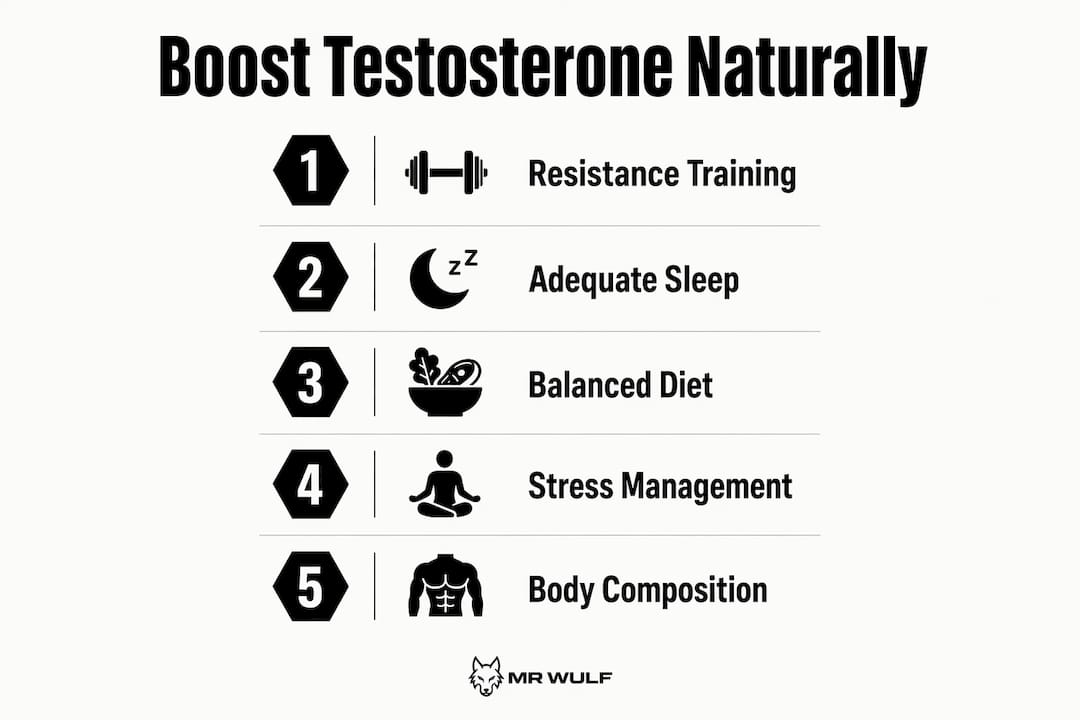
Testosterone is the primary anabolic hormone governing muscle mass, libido, energy, mood, and metabolic rate in men. The good news, backed by solid research, is that lifestyle factors dominate testosterone levels far more than age does. Men who remain physically fit and maintain a healthy weight do not experience the typical age-related decline most assume is inevitable. This guide covers resistance training, sleep, body composition, nutrition, micronutrients, stress management, and evidence-backed supplements. No shortcuts. No unproven claims.
Table of Contents
How Resistance Training Boosts Testosterone Naturally
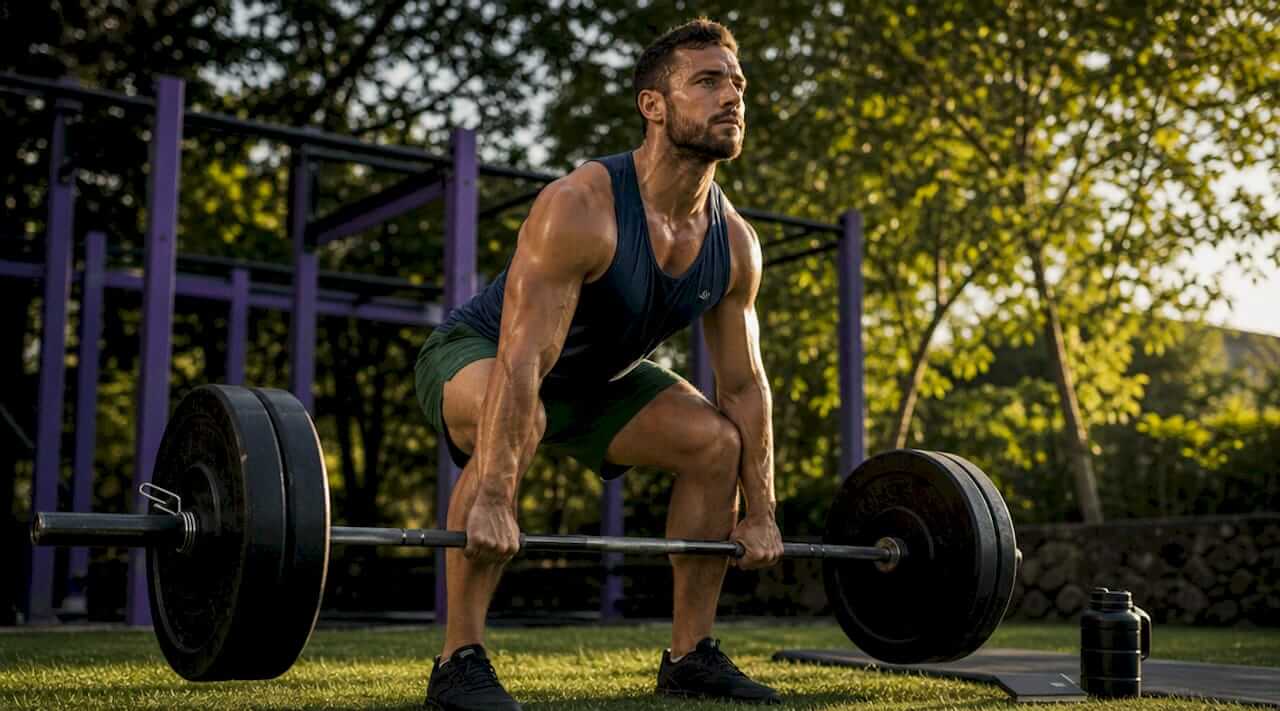
Resistance training with compound lifts is the most potent natural testosterone stimulus available. Squats, deadlifts, bench press, barbell rows, and overhead press recruit the largest muscle groups and trigger the greatest acute hormonal response. Three to four sessions per week, with adequate rest between sessions, is the recommended frequency for sustained testosterone benefits.
Programming matters as much as exercise selection. Sets in the 6 to 10 repetition range with loads at 70 to 85 percent of one-rep maximum produce the strongest testosterone response. Progressive overload — adding weight or reps over time — is what keeps the stimulus growing. Without progression, the body adapts and the hormonal signal plateaus.
One counterintuitive finding worth knowing: excessive endurance training suppresses testosterone via elevated cortisol and high energy expenditure. Long-distance running or cycling performed daily without adequate recovery can actively work against hormonal goals. If you enjoy cardio, keep it moderate and treat resistance training as the non-negotiable foundation.
Tracking lifts in a notebook or app makes progressive overload possible — you can only beat a previous session if you know what you lifted. Consistency over 12 weeks is the minimum timeframe for meaningful endocrine adaptation.
Key exercises to prioritise:
-
Squats: The most effective whole-body testosterone stimulus
-
Deadlifts: Recruits the entire posterior chain maximally
-
Bench press: Upper body compound with strong hormonal response
-
Barbell rows: Balances pressing volume, supports posture
-
Overhead press: Shoulder and upper back with systemic hormonal benefit
Why Sleep Is Your Most Powerful Testosterone Tool
Approximately 80 percent of daily testosterone is produced during sleep, with the bulk released during slow-wave and REM stages. Seven to nine hours of consistent, quality sleep is the clinical target for optimal testosterone production.
The research on sleep deprivation is stark. A landmark University of Chicago study published in JAMA found that one week of restricted sleep at five hours per night reduced testosterone by 10 to 15 percent in healthy young men. That is a larger hormonal swing than most supplements can produce — and it is entirely self-inflicted.
Practical steps to protect testosterone through sleep:
-
Fix your wake time seven days a week — circadian rhythm consistency is more important than total hours alone
-
Keep your bedroom below 19 degrees Celsius — core body temperature must drop for deep sleep to initiate
-
Eliminate blue light exposure for 60 minutes before bed — blue light suppresses melatonin and delays sleep onset
-
Avoid alcohol within three hours of sleep — alcohol fragments sleep architecture and reduces REM duration
-
Screen for obstructive sleep apnoea — CPAP treatment restores testosterone without hormonal medication in men with sleep apnoea, making it one of the most underutilised interventions in men’s health
Sleep disorders are a silent testosterone thief. Many men over 30 have undiagnosed obstructive sleep apnoea, which fragments sleep architecture and crushes overnight testosterone synthesis. If you snore, wake unrefreshed, or feel fatigued despite adequate hours in bed, get a sleep study before spending money on supplements.
For a deeper look at the sleep-testosterone relationship and practical sleep support, the men’s sleep guide and Wulf Sleep formulation cover both the physiology and the intervention in full.
How Body Composition Affects Testosterone Levels
Visceral fat — stored around the abdominal organs — is metabolically active tissue that converts testosterone into oestrogen via the enzyme aromatase. The more visceral fat you carry, the higher your aromatase activity and the lower your free testosterone. Losing 10 percent of body weight can raise total testosterone by 10 to 20 percent in overweight men — a clinically significant shift achievable without a single supplement.
Sustainable fat loss for testosterone preservation requires three things:
-
A moderate calorie deficit of 300 to 500 calories per day — aggressive crash dieting suppresses testosterone by signalling energy scarcity to the hypothalamus
-
High protein intake at 1.6 to 2.2 grams per kilogram of bodyweight — protein preserves lean mass during a deficit and supports LH receptor function
-
Anti-inflammatory eating — processed seed oils, refined sugar, and ultra-processed foods drive systemic inflammation which directly suppresses Leydig cell function in the testes
| Approach | Testosterone impact |
|---|---|
| Moderate deficit (300 to 500 kcal) | Preserves testosterone while reducing aromatase activity |
| Crash diet (greater than 1000 kcal deficit) | Suppresses testosterone via hypothalamic energy sensing |
| High protein (1.6 to 2.2g per kg) | Maintains lean mass and supports LH receptor function |
| Low dietary fat (less than 20% of calories) | Reduces steroid hormone precursor availability |
Nutrients and Supplements That Support Testosterone
Testosterone is a steroid hormone synthesised from cholesterol. Dietary fat and cholesterol are not the enemy. Eggs, red meat, olive oil, avocado, and full-fat dairy provide the substrate the Leydig cells need to produce testosterone. Men eating very low-fat diets consistently show lower testosterone than those eating moderate to high fat.

Zinc is the most critical micronutrient for testosterone. It is required for LH receptor function and testosterone synthesis at the cellular level. Oysters, red meat, pumpkin seeds, and legumes are the highest dietary sources. Deficiency is common in men who sweat heavily through training and do not replace zinc through diet or supplementation. Zinc bisglycinate is the preferred supplemental form — meaningfully superior bioavailability compared to zinc oxide.
Vitamin D3 supplementation at 3,000 to 5,000 IU daily for 12 months increases testosterone by approximately 25 percent in deficient men. Given that most Australian men working indoors are vitamin D deficient by winter, this is one of the highest-return interventions available. Test your 25-OH vitamin D level before supplementing and target a serum level of 80 to 100 nmol/L.
Magnesium glycinate at 300 to 400mg improves free testosterone by reducing sex hormone binding globulin (SHBG) and independently supports sleep quality. This dual benefit makes magnesium one of the most cost-effective supplements in a testosterone optimisation protocol.
For herbal supplements, Tongkat Ali standardised to eurycomanone content and Fenugreek have the most consistent clinical evidence among natural options. A 2022 systematic review and meta-analysis in Nutrients confirmed that properly standardised Tongkat Ali significantly improves serum testosterone in men. Fenugreek works primarily by inhibiting aromatase and 5-alpha reductase, preserving free testosterone. Both require a minimum of eight weeks at clinical doses to produce measurable results.
On ashwagandha: ashwagandha has evidence for reducing cortisol and supporting testosterone in men under genuine chronic stress. The important caveat: many men whose baseline cortisol is not significantly elevated report a noticeable drop in drive and motivation when taking it. When cortisol is already in a reasonable range, pushing it lower can produce flatness rather than calm. Rhodiola Rosea is the preferred adaptogen for most men in the performance context — it supports cortisol management and stress resilience without the drive-suppression profile some men experience with ashwagandha. The adaptogens guide covers the evidence and key distinctions in full.
Supplements with limited or inconsistent evidence include Tribulus terrestris, DHEA outside of confirmed deficiency, and most proprietary testosterone booster blends that underdose every ingredient to fit a cost-per-serving budget. The virility supplements guide provides a candid breakdown of what the evidence actually supports before you spend money.
How Stress Management Prevents Testosterone Decline
Cortisol and testosterone operate on an inverse relationship. When cortisol rises chronically, the hypothalamic-pituitary-gonadal axis downregulates testosterone production. This is not a theory — it is a well-documented endocrine feedback mechanism. Chronic work stress, poor sleep, overtraining, and financial pressure all elevate cortisol and suppress testosterone over time.
Practical lifestyle factors that reduce cortisol and protect testosterone:
-
Limit alcohol to fewer than seven standard drinks per week — alcohol directly suppresses Leydig cell function and elevates oestrogen
-
Reduce exposure to endocrine disruptors — BPA in plastics, phthalates in personal care products, and pesticide residues on food all interfere with androgen signalling; switch to glass or stainless steel water bottles and choose fragrance-free or naturally scented personal care products
-
Practise deliberate recovery — scheduled rest days, walking, and low-intensity activity reduce cortisol more effectively than complete inactivity
-
Support gut health — fermented foods like kefir, kimchi, and sauerkraut support microbiome diversity, which is linked to reduced systemic inflammation and improved oestrogen metabolism
The hormonal health and lifestyle strategies covered on the Mr Wulf Men blog go deeper on the cortisol-testosterone relationship and how to structure your week to minimise hormonal disruption.
Key Takeaways
Natural testosterone optimisation requires consistent execution across sleep, training, body composition, nutrition, and stress management. No single intervention works in isolation.
| Point | Details |
|---|---|
| Resistance training is foundational | Three to four compound lift sessions per week produce the strongest natural testosterone stimulus. |
| Sleep is non-negotiable | Seven to nine hours of quality sleep produces approximately 80 percent of daily testosterone. Treat it as a training variable. |
| Fat loss raises testosterone directly | Losing 10 percent of body weight can increase testosterone by 10 to 20 percent by reducing aromatase activity. |
| Vitamin D3 and magnesium deliver results | Deficient men supplementing with D3 at 3,000 to 5,000 IU can raise testosterone significantly. Test first. |
| Tongkat Ali is the strongest herbal evidence | A 2022 Nutrients meta-analysis confirmed significant testosterone improvement with properly standardised Tongkat Ali. |
What Sustainable Testosterone Optimisation Actually Looks Like
There is something the supplement industry does not want men sitting with: higher testosterone beyond androgen receptor saturation yields diminishing returns for muscle strength and libido. Once receptors are saturated, extra testosterone does not produce extra results. Many men over 30 are chasing a number on a lab report rather than a feeling in their body.
The multi-factorial approach is the only one that holds. A man who sleeps well, trains consistently, eats enough protein and fat, and manages his stress will almost always feel better than a man who takes every supplement on the market but sleeps six hours and drinks on weekends. The fundamentals are the mechanism.
Document your baseline labs before starting — total testosterone, free testosterone, SHBG, vitamin D, and zinc. A 12-week adherence protocol is the minimum timeframe for meaningful endocrine change. Expect gradual progress, not a dramatic transformation in four weeks.
The goal is not to have the highest testosterone of anyone in your gym. The goal is to feel sharp, strong, and capable well into your 50s and 60s. Those are not the same target, and confusing them leads to frustration and unnecessary intervention.
Further Support
The Mr Wulf Men blog covers the full hormonal and performance picture — sleep, nutrition, adaptogens, and supplement formulation — with the same standard throughout.
Explore Mr Wulf Men Supplements
WULF Test — Daily Men’s Formula for Drive, Output and Resilience Tongkat Ali standardised to 5% eurycomanone, Shilajit at 54% fulvic mineral complex, Rhodiola Rosea, Cistanche, Zinc Bisglycinate, Boron, Vitamin D3, L-Selenomethionine, and AstraGin. Every ingredient at a clinically relevant dose. Transparent label. No proprietary blends. View Wulf Test
Wulf Sleep — Natural Sleep Support Formula Sleep produces 80 percent of daily testosterone. Restoring sleep architecture is the highest-leverage testosterone intervention available. Ten clinically dosed ingredients targeting the mechanisms that disrupt sleep quality in men over 30. View Wulf Sleep
The Performance Stack — Day and Night Coverage Wulf Test and Wulf Sleep together — addressing both the testosterone production environment and the overnight recovery window simultaneously. View The Performance Stack
Frequently Asked Questions
What is the fastest natural way to raise testosterone?
Consistent resistance training combined with seven to nine hours of quality sleep produces the fastest measurable increase in testosterone without supplementation. Both work within two to four weeks when applied correctly.
How long does it take to see results from natural testosterone optimisation?
A 12-week adherence protocol is the minimum timeframe for meaningful endocrine change. Hormonal adaptation is gradual, and most men underestimate how long consistent behaviour change takes to register in lab values.
Does vitamin D actually increase testosterone?
Yes, in men who are deficient. Men with low serum 25-OH vitamin D who supplement with 3,000 to 5,000 IU of D3 daily can see significant testosterone improvement over 12 months. Test first to confirm deficiency before supplementing — it does not raise testosterone in men who are already replete.
Can stress really lower testosterone?
Chronic stress elevates cortisol, which directly suppresses the hypothalamic-pituitary-gonadal axis and reduces testosterone production. Managing sleep, training load, and lifestyle stressors is as important as any supplement in a testosterone optimisation plan.
Is ashwagandha worth taking for testosterone?
Ashwagandha has evidence for reducing cortisol and supporting testosterone in men under genuine chronic stress. However, many men — particularly those whose baseline cortisol is not significantly elevated — report a noticeable drop in drive when taking it. Rhodiola Rosea is the preferred adaptogen for most men in the performance context as it supports cortisol management without that risk.

Nutrition and men's vitality: what changes after 30
Healthy habits for men over 30: practical examples