


The term “male vitality” gets thrown around constantly in supplement marketing, men’s health blogs, and gym circles, yet few people can give you a precise, evidence-based definition. If you have found yourself wondering whether flagging energy, reduced drive, or a general sense of flatness is just “getting older” or something you can actually address, you are not alone.
Male vitality is a broad, non-medical umbrella term spanning physical energy, mental sharpness, mood, sexual function, and metabolic health. This guide cuts through the noise and gives you real answers grounded in science.
Table of Contents
Key Takeaways
| Point | Details |
|---|---|
| Vitality is a system, not a single metric | True male vitality includes physical, mental, sexual, and metabolic function. Reducing it to a testosterone number misses most of the picture. |
| Lifestyle is the primary lever | Resistance training, sleep quality, body composition, and stress management drive the vast majority of vitality outcomes. |
| Most marketed supplements underdeliver | The gap between marketing claims and clinical evidence is substantial. Form, dose, and standardisation determine whether an ingredient actually works. |
| Tongkat Ali and Rhodiola have the strongest current evidence | Among botanical ingredients, these two have the most consistent clinical support for testosterone and cortisol outcomes respectively in men over 30. |
| Persistent symptoms warrant medical assessment | Low energy and low drive in men over 30 have many potential causes beyond hormonal decline. Get a full workup before pursuing interventions. |
Defining male vitality: looking beyond the surface
Most men, when they hear “male vitality,” think about testosterone levels, gym performance, or libido. That is understandable. Supplement marketing has spent decades reinforcing that association. But the clinical reality is more layered.
Male vitality is not simply the absence of disease. It is your active capacity to function well across multiple domains simultaneously. A man can have testosterone in the normal reference range and still feel exhausted, foggy, and unmotivated. Conversely, a man with modestly lower testosterone can feel sharp, energetic, and driven if his sleep, nutrition, stress management, and metabolic health are in order.
The genuine pillars of male vitality include:
-
Physical energy and stamina: the capacity to sustain activity without excessive fatigue
-
Cognitive clarity and focus: mental sharpness, decision-making, and emotional regulation
-
Sexual health and function: libido, erectile function, and reproductive capacity
-
Metabolic health: insulin sensitivity, healthy body composition, and cardiovascular function
-
Psychological resilience: mood stability, stress tolerance, and motivation
-
Recovery capacity: how quickly the body bounces back from physical and mental exertion
Understanding hormonal health as one input into this system, rather than the whole system, is the first and most important reframe. Everything else follows from that shift.
The hormonal link: testosterone and male vitality
Testosterone genuinely matters for male vitality — just not in the simplistic way most men assume.
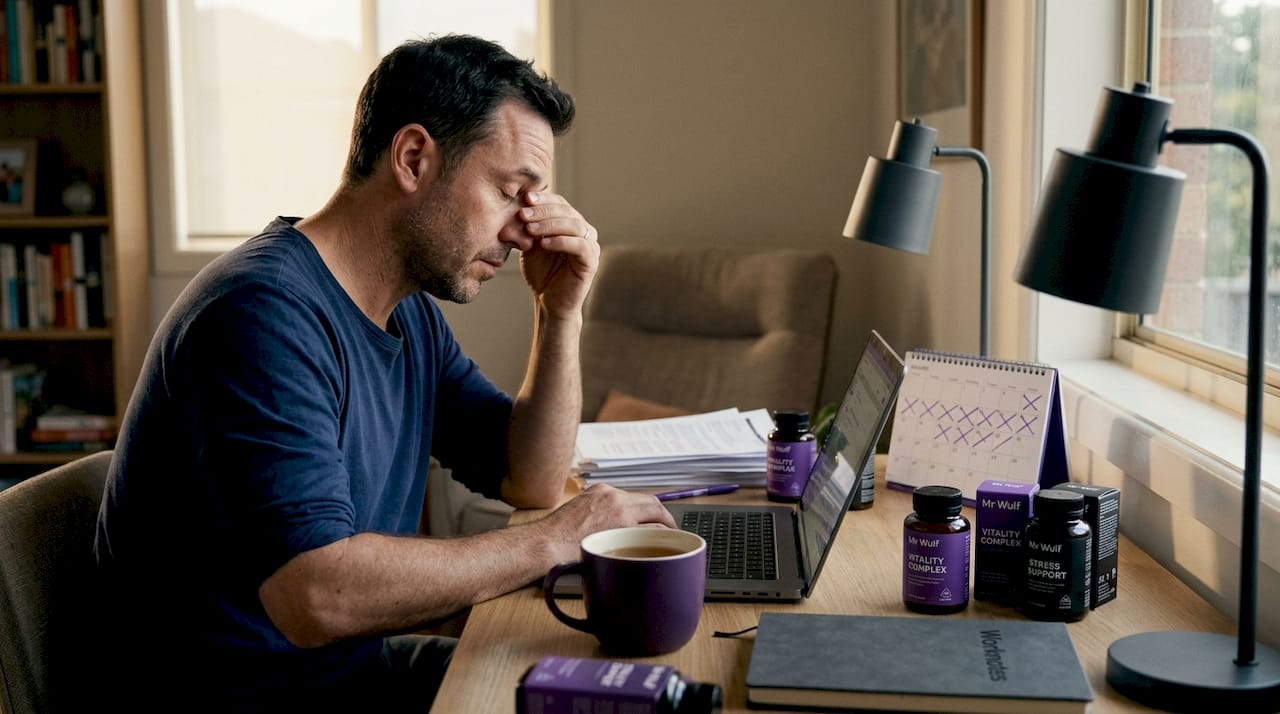
Testosterone declines gradually from a man’s mid-30s, but the symptoms associated with low testosterone — fatigue, low libido, brain fog, mood changes — overlap significantly with other common conditions including poor sleep, depression, metabolic syndrome, and thyroid dysfunction. This overlap is critically important. Pursuing a testosterone intervention without ruling out these other drivers is a common and costly mistake.
| Symptom | Possible hormonal cause | Possible non-hormonal cause |
|---|---|---|
| Low energy | Low testosterone | Poor sleep, anaemia, hypothyroidism |
| Reduced libido | Low testosterone | Stress, relationship issues, depression |
| Brain fog | Low testosterone | Sleep deprivation, high cortisol, poor diet |
| Mood changes | Low testosterone | Anxiety, depression, chronic stress |
| Reduced muscle mass | Low testosterone | Physical inactivity, poor protein intake |
| Weight gain | Low testosterone | Sedentary behaviour, excess caloric intake |
For men with confirmed hypogonadism — clinically low testosterone with supporting symptoms — testosterone therapy can improve function meaningfully. But it requires rigorous diagnosis, not just a borderline blood test. Risks include effects on fertility, haematological changes, and cardiovascular considerations that vary by individual profile. It is not a casual decision.
The responsible path is straightforward. Get a thorough workup. Measure total testosterone, free testosterone, luteinising hormone (LH), sex hormone binding globulin (SHBG), and thyroid function at a minimum. Work with a GP who understands the nuance of hormonal balance in men rather than one who either dismisses your symptoms or immediately reaches for a prescription.
If your testosterone is in the lower-normal range and you are symptomatic, look at sleep quality, body fat percentage, and alcohol intake before assuming you need hormone intervention. These three lifestyle variables alone can shift testosterone levels meaningfully without pharmacological support.
Beyond Hormones: Lifestyle, Fitness, and Energy
Lifestyle choices are the most powerful and modifiable drivers of male vitality for the vast majority of men. This is where the real leverage is, and it is consistently underestimated.
Excess adipose tissue, particularly around the abdomen, increases aromatase activity — the enzyme that converts testosterone to oestrogen — which actively suppresses testicular testosterone output. Men who maintain a healthy body weight, exercise regularly, and prioritise sleep maintain substantially better hormonal profiles and subjective energy levels compared to sedentary peers with excess visceral fat. The mechanisms are physiological, not motivational.
Comparison: active versus sedentary men over 40
| Health marker | Active, healthy weight | Sedentary, overweight |
|---|---|---|
| Total testosterone | Higher, better maintained | Tends to decline faster |
| Sleep quality | Typically better | Often disrupted |
| Cardiovascular fitness | Preserved | Declines more sharply |
| Insulin sensitivity | Better | Reduced, increased metabolic risk |
| Subjective energy levels | Higher | Lower, more variable |
| Cortisol regulation | More efficient | Chronically elevated |
Lifestyle interventions with the strongest evidence for men over 30:
-
Resistance training at least three times per week: directly stimulates testosterone production, preserves muscle mass, and improves insulin sensitivity
-
Achieving and maintaining a healthy body weight: reduces aromatase-driven testosterone suppression and lowers systemic inflammation
-
Prioritising seven to nine hours of quality sleep: the majority of daily testosterone production occurs during slow wave sleep; chronic sleep deprivation reduces testosterone by 10 to 15% as confirmed by a 2011 University of Chicago study
-
Managing chronic stress: persistently elevated cortisol directly suppresses the hypothalamic-pituitary-gonadal axis, the hormonal pathway driving testosterone production
-
Limiting alcohol: regular heavy intake disrupts sleep architecture and directly impairs testicular testosterone synthesis
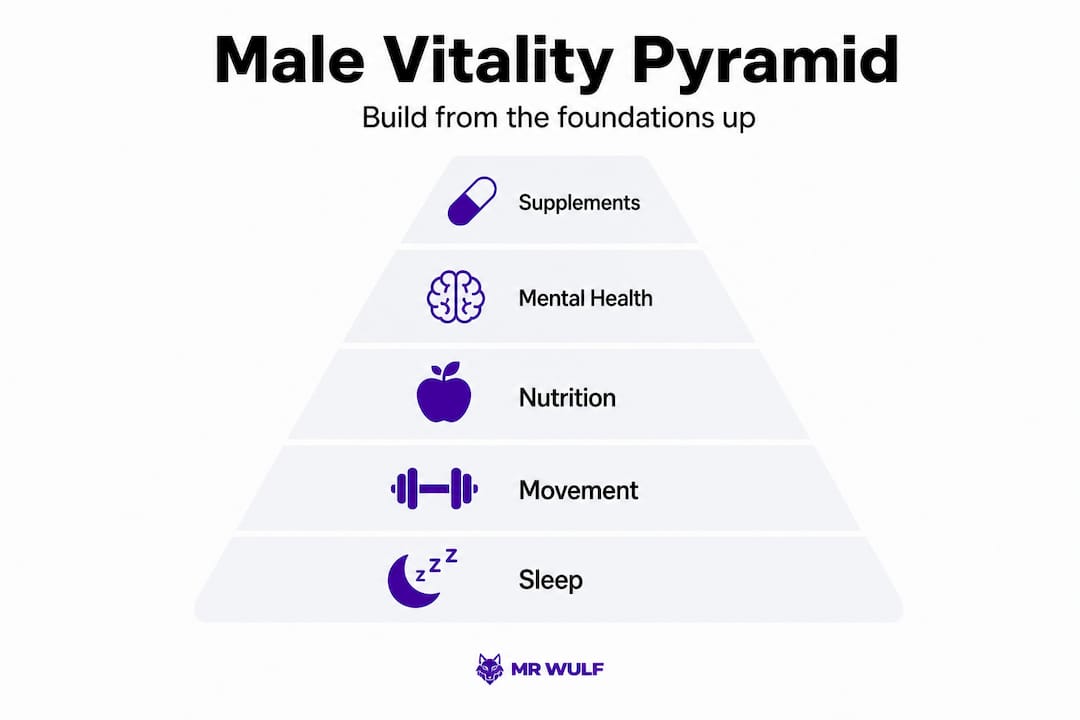
These lifestyle interventions compound on each other. Better sleep supports recovery from exercise. Better body composition improves hormonal signalling. Reduced stress allows deeper sleep. Each improvement reinforces the others, and the combined effect outperforms any supplement stack built on top of a broken foundation.
Sleep is the single most high-impact change most men can make. Nothing undermines male vitality faster than chronic sleep debt. Consistent bed and wake times, a cool and dark room, and removing screens and stimulants before bed are the starting points. If sleep quality is a persistent problem, the underlying mechanisms — cortisol management, brainwave transition, GABAergic tone — are addressed specifically in the Mr Wulf Men sleep science series.
Supplements for Male Vitality: Science Versus Hype
Many men reach for supplements after addressing lifestyle foundations, which is a reasonable approach when the right formulations are chosen. The problem is that the gap between marketing claims and clinical evidence in the male vitality category is enormous.
The honest position is that most supplements marketed broadly for “male vitality” have limited high-quality evidence behind them. Products like saw palmetto, widely sold for prostate and sexual health claims, show no clear clinical benefit in rigorous trials. Tribulus terrestris is heavily marketed and poorly evidenced in healthy men. Maca root has some evidence for improved libido and mood but the effect sizes are modest and the evidence base is not deep.
The ingredients that do have meaningful clinical support, at the right doses and in the right forms, are worth understanding specifically:
Tongkat Ali — standardised to eurycomanone content The most consistently evidenced botanical for testosterone support in men over 30. A 2022 systematic review and meta-analysis published in Nutrients confirmed significant improvements in serum testosterone across multiple human trials. The eurycomanone standardisation percentage is the key marker — it confirms the active compound is present at a therapeutic concentration. A generic extract without this standardisation is not clinically equivalent. A 2024 study in Sleep Advances also confirmed that Tongkat Ali enhances NREM sleep consolidation in middle-aged men, directly linking testosterone support to sleep architecture improvement.
Rhodiola Rosea — standardised to 3% rosavins, 1% salidroside The preferred adaptogen for cortisol management in the male vitality context. A clinical trial published in Phytomedicine confirmed significant cortisol reduction without the drive-suppression profile seen with other adaptogens. Rhodiola supports stress resilience and physical endurance without blunting motivation — a meaningful distinction for men who need to perform during the day.
Ashwagandha — with a specific caveat Ashwagandha has reasonable evidence for testosterone and libido support in men under genuine chronic stress. The important caveat: many men — particularly those whose baseline cortisol is not significantly elevated — report a noticeable drop in drive and motivation when taking it. When cortisol is already in a normal range, suppressing it further can produce flatness rather than calm. It works for the right person in the right context. It is not a universal recommendation.
Zinc bisglycinate Genuine evidence for supporting testosterone in zinc-deficient men. The chelated form has significantly better bioavailability than zinc oxide. In men with already-adequate zinc status, supplementation does not raise testosterone further. At chronically high doses it competes with copper absorption. Test before supplementing.
Magnesium glycinate Consistently associated with better sleep quality and testosterone in men with low dietary intake or high physical activity. Many men over 30 are running below optimal magnesium levels due to stress, training, and diet. The glycinate form absorbs meaningfully better than oxide.
Vitamin D3 Functions more like a hormone than a vitamin. Deficiency is extremely common in men who spend most of their time indoors and is directly associated with lower testosterone in multiple population studies. Supplementation in deficient men produces consistent hormonal improvements. A dose of 3,000 to 5,000 IU is meaningful for the Australian market — lower doses often produce insufficient impact on serum levels in deficient individuals.
What the evidence does not support at effective doses: Saw palmetto, tribulus terrestris, and most proprietary “vitality blend” products without transparent individual ingredient dosing. Pixie dusting compounds at sub-therapeutic doses is arguably worse than taking nothing — it creates false confidence that a deficiency is being addressed when it is not.
What Most Men Get Wrong About Vitality
Most men approach vitality backwards. They reach for a supplement before fixing sleep. They get a single testosterone test without clinical context and then fixate on the number. They assume a decline in energy after 35 is inevitable and either accept it passively or purchase products that promise rapid reversal. Neither response is useful.
The men who genuinely maintain and reclaim vitality into their 40s, 50s, and beyond are not the ones with the most impressive supplement stacks. They are the ones who have built consistent, evidence-based habits around sleep, movement, weight management, and stress. These things are not exciting to sell, which is why the industry consistently undersells them in favour of whatever the next trending ingredient happens to be.
There is also a troubling tendency to ignore mood and psychological wellbeing when assessing vitality. Depression and anxiety are among the most common and most underdiagnosed causes of fatigue, low libido, and loss of motivation in men over 30. Persistent low mood that does not resolve with lifestyle adjustment warrants professional support — not a new supplement and not a louder inner voice telling you to push through. If your symptoms are persistent, affecting your daily life, and not responding to lifestyle changes, see your GP. Not a wellness influencer. Not a supplement brand. A doctor who can run comprehensive diagnostics and assess the full picture.
The supplements that work, work as precision tools on top of a solid lifestyle foundation. They close specific gaps. They modestly amplify what consistent habits are already building. They are not substitutes for the foundation, and the brands that position them as such are doing men a genuine disservice.
Further Support
The Mr Wulf Men blog covers the clinical detail behind each of these topics — the testosterone-sleep loop, sleep supplement formulation, men’s hormonal health, and performance habits — with the same standard applied here: mechanism first, marketing never.
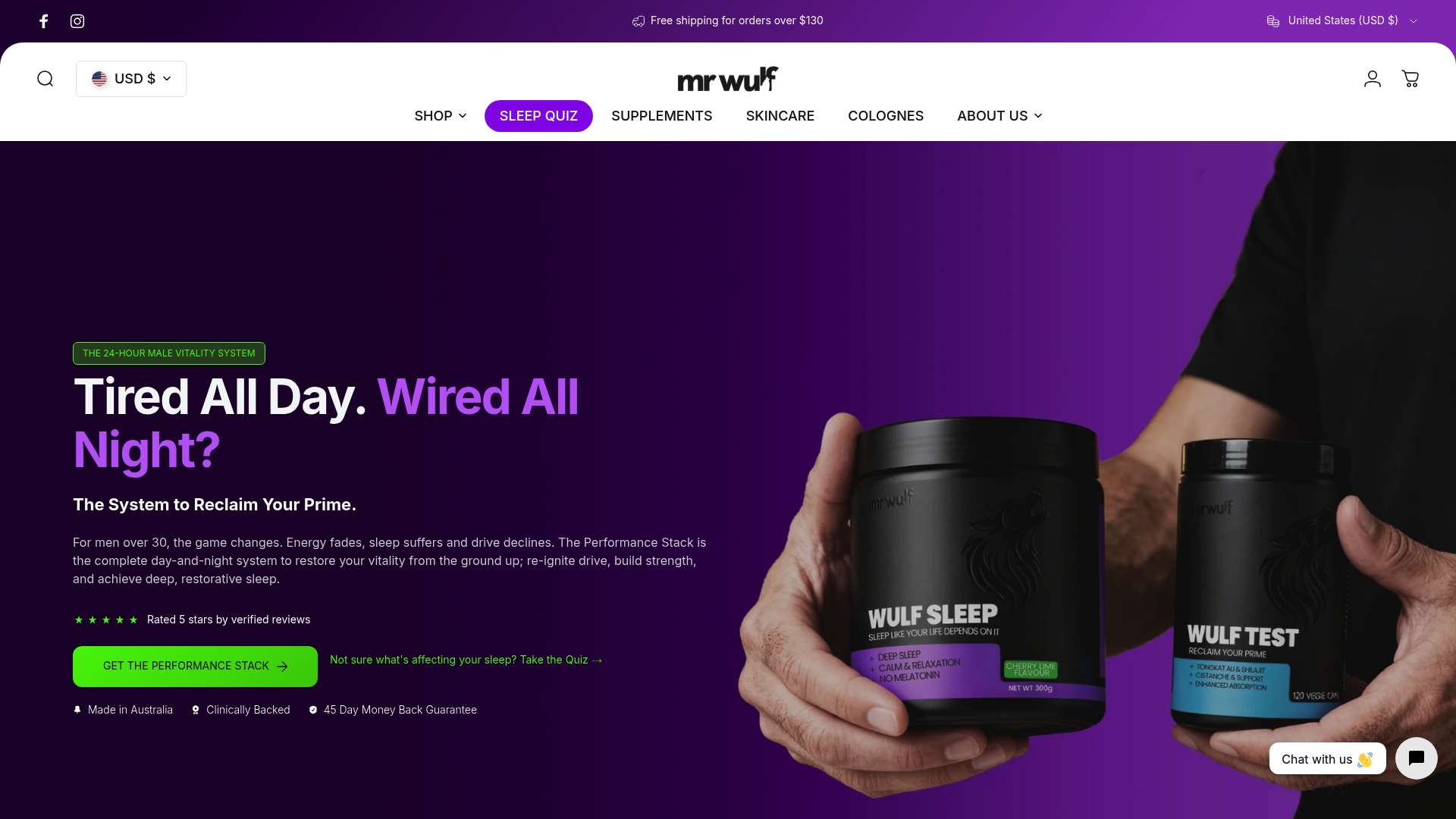
Explore Mr Wulf Men Performance Supplements
WULF Test — Daily Men’s Formula for Drive, Output and Resilience Tongkat Ali standardised to 5% eurycomanone, Shilajit at 54% fulvic mineral complex, Rhodiola Rosea, Cistanche, Zinc Bisglycinate, Boron, Vitamin D3, L-Selenomethionine, and AstraGin. Every ingredient at a clinically relevant dose. Transparent label. No proprietary blends. View Wulf Test
Wulf Sleep — Natural Sleep Support Formula Ten clinically dosed ingredients for men whose sleep quality has declined. Addresses sleep onset, evening cortisol, and deep sleep architecture — the overnight foundation that male vitality depends on. View Wulf Sleep
The Performance Stack — Day and Night Coverage Wulf Test and Wulf Sleep together, for men who want to support both daytime drive and overnight recovery in a coordinated system. View The Performance Stack
Frequently Asked Questions
Is male vitality just about testosterone?
No. Vitality spans energy, mood, cognitive function, metabolic health, and physical performance. Testosterone is one contributing factor within a much larger system. A man with normal testosterone and poor sleep, chronic stress, and excess body fat will still feel flat. The system as a whole is what matters.
Can supplements really improve male vitality?
Some supplements have meaningful clinical evidence for specific mechanisms — Tongkat Ali for testosterone, Rhodiola for cortisol management, magnesium glycinate for sleep quality, zinc and vitamin D3 for men with identified deficiencies. Many supplements marketed broadly for vitality have very limited evidence at the doses used. Choosing products with transparent, individually dosed formulations is the only reliable approach.
When should I see a doctor about low energy or vitality?
If symptoms are persistent, progressive, and affecting your daily function — and do not respond to sleep improvement, exercise, and stress management — see your GP for a full hormonal and metabolic assessment. Low vitality in men over 30 has many potential causes beyond testosterone decline, and identifying the actual driver is essential before pursuing any intervention.
Does lifestyle change really make a difference for men over 30?
The evidence is unambiguous. Physically active men maintaining a healthy body weight consistently retain better hormonal profiles, sleep quality, and subjective vitality into their 40s and 50s compared to sedentary peers. The combined effect of sleep, resistance training, body composition management, and stress reduction can produce a 15 to 25% testosterone improvement — comparable to the lower end of some pharmaceutical interventions, without the associated risks.
Is a decline in vitality inevitable with age?
Some gradual change is normal. Significant, life-affecting decline is not inevitable and is meaningfully modifiable through lifestyle. Many men maintain excellent energy and function well into their 50s and 60s with the right foundations in place. The compounding effect of consistent habits over years is the variable that makes the biggest difference.



Virility supplements: what works and what to avoid
Adaptogens in men's supplements: what science says